Said the Dead
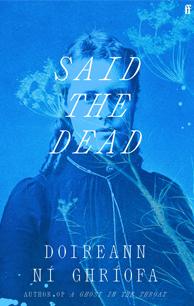
“The more she learned, the more certain she became: this other world was alive and true and trembling, and very close to her own.
Now she had a secret”
In the city of Cork, a derelict Victorian mental hospital is being converted into modern apartments. One passerby has always flinched as she passes the place. Had she lived in another time, she too might have found herself held within those walls.
Now, she notices a sign: FOR SALE.
It is the first of many signs. Guided by an irresistible impulse, she follows them. Soon, she is trespassing, stealing, absconding from the routine of mother, spouse, daughter, as she uncovers a chorus of startling voices: those of the women who knew the hospital best. They murmur from archives and old records. They haunt from stairwells and walls. In them - and in one figure in particular - she may find meaning and solace, righteous anger, salvation even. Or her final vanishing?
A work of sublime intensity and tenderness, 'Said the Dead' breaks the boundaries between worlds -- past and present, imagined and real, fact and fiction -- to make something new and lasting: an experience full of danger, full of love and full of truth.
About the author
Doireann Ní Ghríofa is an Irish writer. Her most recent book, 'A Ghost in the Throat', won the James Tait Black Prize, the An Post Book of the Year and was shortlisted for the Rathbones Folio Prize. She is also the author of seven critically acclaimed books of poetry.
Judge Hari Kunzru on Said the Dead
“What the cultural historian Saidiya Hartman has called ‘the violence of the archive’ is both a kind of silence – what is not recorded – and a kind of distortion. People, particularly marginal people, appear hazily, if at all, in records made in order to discipline or organize them. In Said the Dead, Doireann Ní Ghríofa recovers the forgotten stories of women incarcerated in a Cork asylum in the late nineteenth and early twentieth centuries. Reaching backwards into the past, she orchestrates a polyphony of voices, reminding us that fiction has an ethical purpose as well as an aesthetic one.”