What Am I, A Deer?
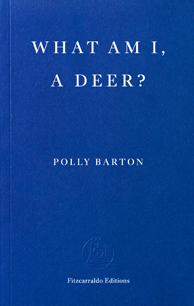
What does it mean to lose yourself – and is that something you should be aiming for? A young woman with little interest in games takes up a job in Frankfurt at a famous gaming company, naively set on reinvention. On her morning commute, in the familiar clutches of tedium and self-loathing, she encounters a nice-eyed stranger who returns her forgotten umbrella and finds herself catapulted into a dizzying, year-long whirlwind of obsession – not just with this endlessly attractive spectre, but also with the feverish karaoke trips from which she draws the ultimate solace. With astonishing existential acuity, Polly Barton’s formidable debut novel renders the paradoxes of modern life in all its complexity, in deliriously self-conscious prose that is at once propulsive, titillating and bitingly funny. Echoing with the sounds of Whitney Houston and The Cure, reaching for the sublime in dark, sweaty boxes, 'What Am I, A Deer?' is an exhilarating exploration of authenticity, fantasy, romance and intoxication.
About the author
Polly Barton is a writer and Japanese literary translator. Her translations include 'Butter' by Asako Yuzuki, 'Hunchback' by Saou Ichikawa, 'Where the Wild Ladies Are' by Aoko Matsuda, and 'There’s No Such Thing as an Easy Job' by Kikuko Tsumura. She has published two works of non-fiction, 'Fifty Sounds', for which she won the 2019 Fitzcarraldo Editions Essay Prize, and 'Porn: An Oral History'. 'What Am I, A Deer?' is her debut novel.
Judge Francis Spufford on What Am I, A Deer?
“Sometimes the frontier for innovation in the novel is an interior one. In Polly Barton’s What Am I, A Deer? a young woman goes to work for a German videogames company, and develops a deep romantic fixation on a man she sees every morning on her tram ride to work. That’s pretty much it, in terms of external action, but the book performs an extraordinary, lucid tracing of the very fabric and texture of her thinking, finding a flowing and intricate and almost obsessional language for consciousness that picks up but then extends the great modernist experiments in charting minds in motion.”