Goldsmiths logo
Imagebar

MPhil & PhD in Music

Student comment:
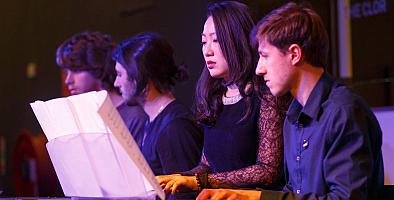
"The department invites world class musicians to regular concerts and lectures at the College, so these are very exciting opportunities for students. Also it is a wonderful environment for the academic study of both classical music and pop music."

Mizuka, PhD in Music

Attendance:
3-4 years full-time or 4-6 years part-time; see starting your research studies.
Applying: Application forms are available from, and should be returned to, either the Admissions Office or the International Office. We recommend that you apply as early in the academic year as possible, as there are fixed deadlines for specific funding sources.

Find out more about applying

Entrance requirements:
We prefer you to have a Masters degree, or to be studying for one at the time of your application. However, we will consider applicants with a good undergraduate degree. If your first language is not English, please check our English Language requirements.
Funding:

Please contact the Department of Music for details of any studentships that might be offered.

Fees:
Please see Tuition fees.
Staff research interests:
Please see Staff research interests.
Contact the department:
Contact Keith Potter
About the department:
Music

Download a booklet [PDF, 712KB]


Goldsmiths’ Department of Music has a lively and varied research base, large postgraduate community, active performing tradition, and offers proximity to London’s resources. Staff research interests are correspondingly diverse and wide-ranging, and we offer research supervision in any of these areas of specialism.

What you study

You can study full-time or part-time for a research degree. The programme normally begins in September but applications for entry in January and April may be considered. You may register for one of four options:

  • written thesis of up to 100,000 words in any area of musicology, contemporary music studies, analysis or ethnomusicology (MPhil: 60,000 words)
  • composition: portfolio of compositions, and 20,000-word commentary (MPhil: 12,000-word commentary)
  • Sonic Arts: portfolio of practice and 40,000 - 60,000 words commentary (MPhil: 20,000 - 30,000 commentary)
  • performance: full-length recital and related 50,000-word thesis (MPhil: lunchtime recital and 30,000-word thesis); topics might include such areas as contemporary music studies, ethnomusicology, or aspects of historical performance.

Supervision is available in any of the areas of specialism outlined above or covered by staff research interests. In particular circumstances we may be able to arrange supervision with specialists outside the Department. Research students are strongly encouraged to contribute to the Department’s research culture. You have regular opportunities to present papers at seminars and conferences.

Composers can have pieces performed or recorded by College ensembles, including the Sinfonia; or by the Ensembles-in-Residence. Performers are encouraged to take part in Departmental concerts, and may audition for concerto appearances.

Registration and study
Initially, you register for a Master of Philosophy (MPhil) programme to train you in the research methods you will need to complete a PhD. You can apply to transfer to PhD registration when you have satisfactorily completed an agreed part of the research and training programme; this usually happens after approximately 18 months if you are studying full-time, or before 36 months if part-time. You should aim to complete and submit your PhD thesis within an agreed period, usually three to four years for full-time students, and four to six years for part-time. If you decide not to upgrade to PhD registration, you can submit your thesis for an MPhil after two years if you are studying full-time, or after three years if part-time. With the agreement of your supervisor, you can change your registration from full to part-time or vice versa; the necessary form is available from the Registry Programmes Office.

North American applicants especially should note that the British system does not include preparatory taught classes or examinations as part of the MPhil/PhD programme, except for an initial course in research methods.

Research supervision
You are assigned members of staff qualified to supervise your research throughout your period of registration. Supervision involves regular meetings throughout the period of study, and ideally involves the development of an intensive intellectual relationship between you and your supervisor, from which both parties gain.

Facilities
You have access to Goldsmiths’ Graduate School, based in Hatcham House, containing an open-access computer room, a student common room and seminar room for use by postgraduate research students. See the Graduate School pages for more information.

See also information on our current PhD Students and their research interests.

Register your interest

If you register your interest in this programme we will keep you informed about open days and send you relevant further information. If you subsequently decide to apply for this programme you will be able to use the same login details to apply.


Goldsmiths, University of London, New Cross, London, SE14 6NW, UK
Telephone: + 44 (0)20 7919 7171

Goldsmiths has charitable status

© 2012 Goldsmiths, University of London. Copyright and Disclaimer

Sitemap

Edit