Politics of Patents: From the V&A to the Smithsonian
European Research Council funded project examining historical clothing patents features in two interactive installations at the V&A in London and the Smithsonian Institution in Washington.
Thousands of visitors at the Victoria & Albert Museum and the Smithsonian Institution engaged with interactive installations reimagining historical clothing patents – one through AI-generated designs, the other through hands-on exploration of patented sportswear.
Speculative sewing AI at the V&A
At the 2024 Digital Design Weekend – the V&A’s annual showcase of global creative practices at the intersection of art, design, and technology – Goldsmiths-based research project Politics of Patents (POP) presented Speculative Sewing AI, an interactive installation developed in collaboration with Jamie Shilvock, a graduate of Goldsmiths’ MA Computational Arts programme.
Led by Professor Kat Jungnickel and funded by the European Research Council, POP explores 200 years of clothing inventions, uncovering how patented garments challenge norms, disrupt politics, and enable new expressions of identity and citizenship.
Speculative Sewing AI invited visitors to submit clothing problems – from the practical to the whimsical – which were interpreted by an AI trained on hundreds of thousands of patents (1820–2020), generating imaginative design responses that blended historical logic with speculative futures.
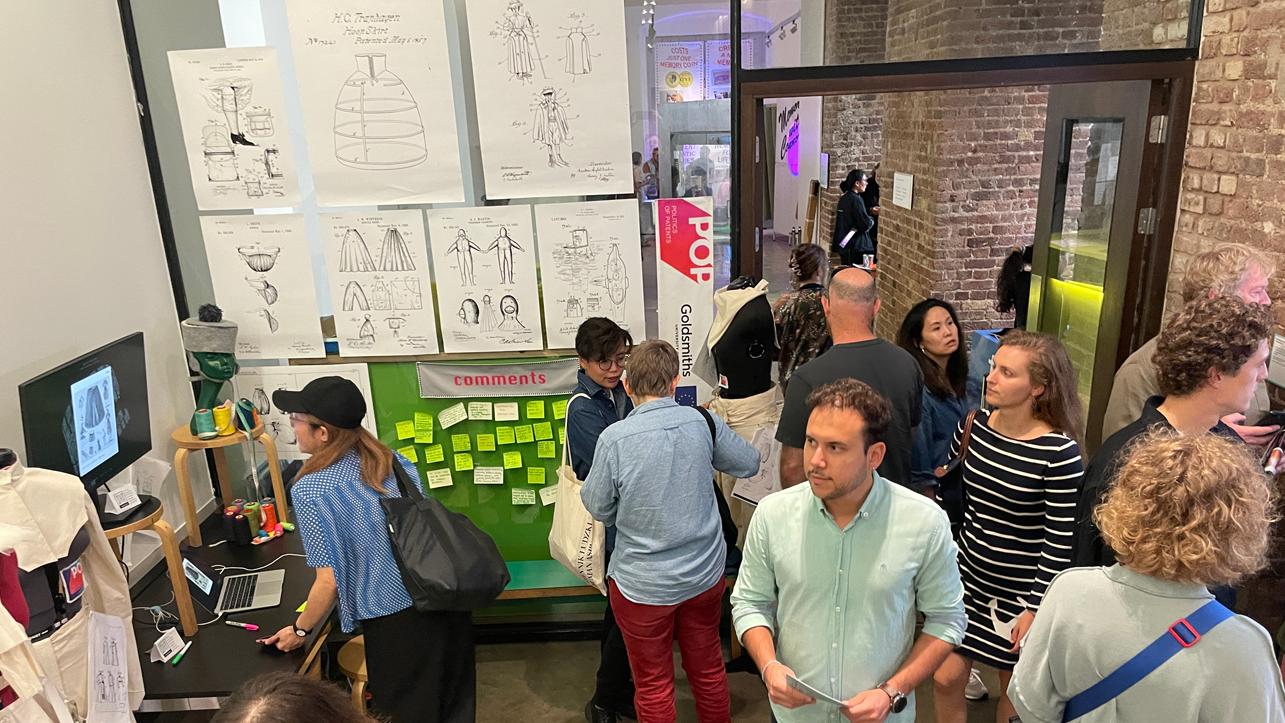
POP at the V&A Digital Design weekend
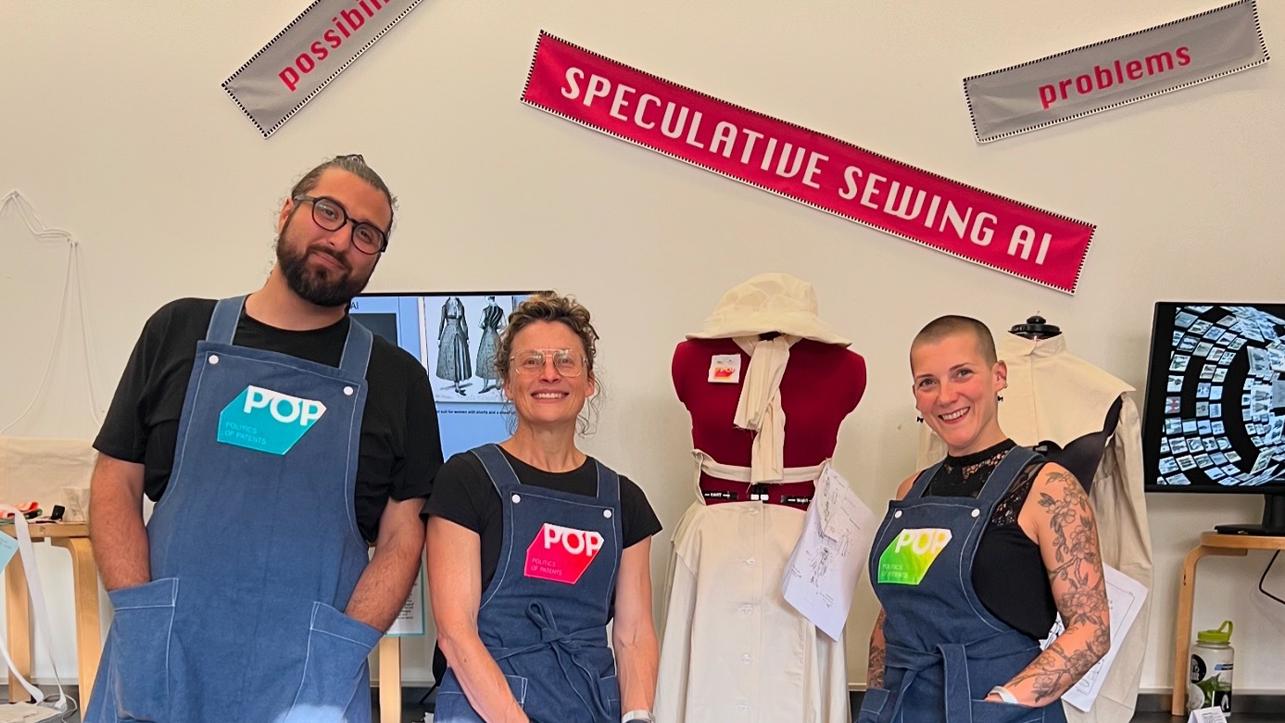
Some of the POP team
Visitors co-created an eclectic archive of concepts, from jackets that turn into sunshades to hoop skirts that carry butterflies. Over 2.5 days, 458 prompts were submitted, with even more interactions occurring as people discussed, brainstormed, and explored the growing archive of visual outputs.
Pockets emerged as a recurring theme – not just their absence, but their radical potential. Submissions included overalls for dog walking and gardening dresses with seed, soil, and tool pockets – reflecting autonomy, care, and resistance to fast fashion.
Each prompt revealed something about contemporary life: accessibility, climate anxiety, overconsumption, and desire for autonomy. The installation became a playful, critical space where AI met human imagination.
Studying design problems and solutions in past patents provide a glimpse into what is important to people and how they have attempted to change the world even in small and mundane ways, stitch by stitch.
Kat Jungnickel
The installation, developed with support from Goldsmiths’ public engagement team, also sparked deeper conversations about AI’s usefulness and ethics in design. While the AI generated surprising visuals, it lacked true understanding. As Professor Jungnickel noted, “Some outputs were inspiring, but they required significant skill and imagination to take further.”
Mishaps – from extra limbs to unexpected tails – were humorous but provoked thoughtful discussion about authorship, responsibility, and the limits of AI in creative practice.
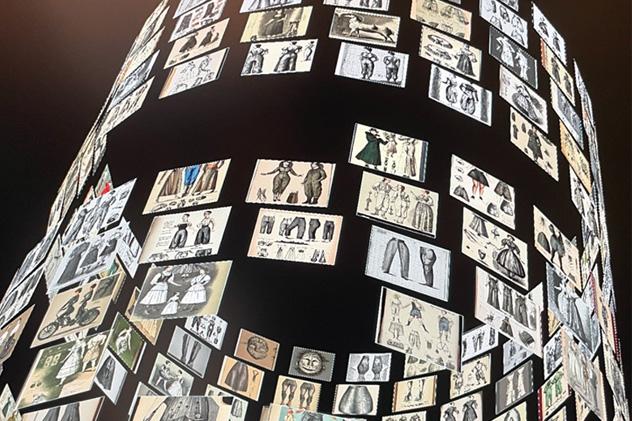
The AI model was trained on hundreds of thousands of clothing patents from 1820–2020.
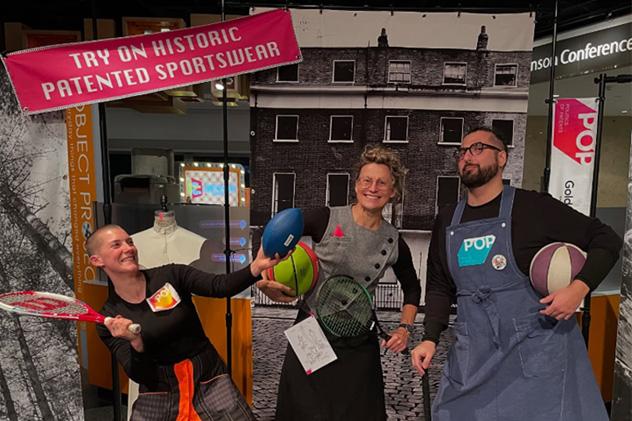
An interactive workshop at the Smithsonian museum
Visitors also left handwritten reflections on a post-it board, questioning AI’s role: “We think it knows – but what in fact does it know?” and “Reassured that I could still do better on my own!” The board became part of the exhibition, capturing curiosity and critique in real time.
A fantastic showcase and drop-in design experience.
V&A
From London to Washington, D.C
POP was invited to the Smithsonian’s National Museum of American History in Washington DC, for a collaborative event with the Lemelson Center for the Study of Invention & Innovation and the US Patent Office.
The team ran interactive sessions including a mini-exhibit, hands-on workshops, and an Invent Your Own Sportswear activity. Visitors tried on reconstructed patented garments, posed for portraits, and discussed how clothing innovation reflects social change.
Nearly 2,000 visitors took part in a single day – from school groups to families and museumgoers. Professor Jungnickel also led Q&As and stage demos, further exploring fashion, invention, and politics.
Looking ahead
These events reinforced the value of POP’s work – offering rich engagement data and sparking new research directions. Whether through AI or hands-on workshops, the installations showed how inventive clothing can challenge conventions and inspire new ideas.
Looking forward, the team plans to refine and reconstruct experimental designs and is exploring funding to deepen and expand the research.
From the V&A to the Smithsonian, POP has shown how past inventions can spark present-day creativity and dialogue around clothing, technology, and social change.
These events are part of the POP project which has received funding from the European Research Council (ERC) under the EU’s Horizon 2020 research and innovation programme. Grant No: 819458