BA (Hons) Fine Art
Content navigation menu
Why study BA Fine Art at Goldsmiths
Please note, we are still accepting applications for 2026 entry for BA Fine Art. You can apply through UCAS.
Study the practice and theory of fine art in a dynamic, critical and international context.
- Goldsmiths' School of Art has a longstanding, worldwide reputation for excellence
- You will have your own studio space from day one, with access to excellent technical facilities, across a broad range of media
- You will employ your analytical capabilities to develop your own studio practice, in combination with a course of critical studies lectures and seminars
- You will be taught by a team of artists, curators and writers, who will help you develop ideas, focus your research, and respond to a range of influences
- You will meet visiting artists and guest speakers, who will provide additional perspectives drawn from a diverse and international context
Contact
If you have specific questions about the degree, contact the Art Admissions Team (Home/EU applicants) , Lucy Clout (international applicants)

What you'll study
The programme has two elements that inform each other:
- Studio practice (75% of the course)
- Critical studies (25% of the course)
Click on the tabs to find out more about each element.
Teaching style
You will be given a dedicated studio space that will become the focal point of your activities. You will be encouraged to work in any medium you choose. You will be allocated a personal tutor each year and you will determine the nature of your practice through discussion with tutors.
How you'll be assessed
Studio practice coursework is continuously assessed through individual tutorials, group seminars and crits. This is complemented by studio presentations at Year 1, viva voce at Year 2, and a final exhibition at Year 3.
Critical Studies is assessed through essays (Years 1 and 2) and a dissertation (Year 3).
Watch videos about your course
Facilities
BA Fine Art studios are located in the purpose-built Ben Pimlott Building, Laurie Grove Baths and St James Hatcham Building, with seminar rooms and spaces to test out temporary projects, performance and installations, in all of them.
Some of your practical work will take place in specialist Art Practice Areas, staffed by highly skilled artist technicians to help you realise your ideas:
- 3D printing
- Casting
- Constructed textiles
- Fine art print
- Graphics and time-based media
- Metal
- Photography and moving image
- Stitch and fabric
- Print and dye
- Wood
- Ceramics
You also have access to Goldsmiths-wide facilities.
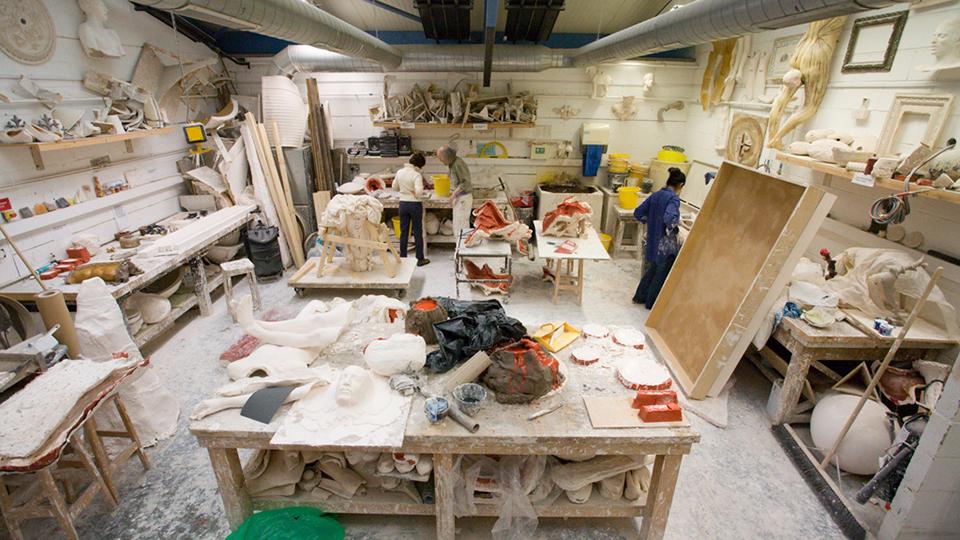
You'll be able to get to grips with art practice areas including casting, metal, print and dye, and fine art print.
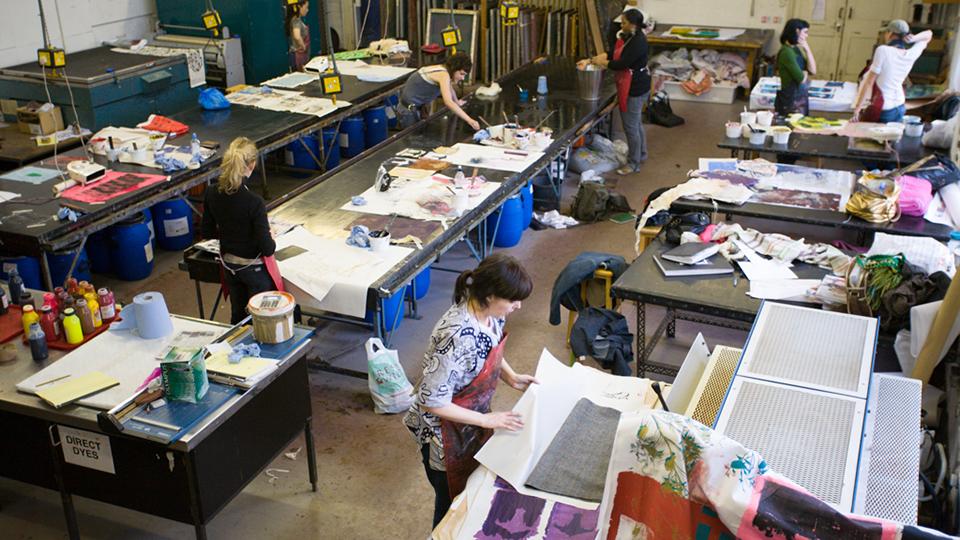
The degree will support your development and creativity, and help you acquire technical and independent learning skills.
Degree Shows
You will work towards a final-year exhibition, which forms part of Goldsmiths' famous annual Degree Shows. These events celebrate the best of students' creative work.
Careers
The interdisciplinary nature of the programme will enable you to work in a variety of fields, for example in the contemporary art world, media, academia, museums and galleries, curating, arts production and technical support, arts administration, and education. Many students also choose to continue their studies to Masters level and beyond. You can read more about potential career paths after graduation on our art careers page.
Many graduates have gone on to be successful practising artists or arts professionals after finishing their studies with us, winning major prizes and exhibiting around the world.
The Turner Prize shortlist has consistently included graduates and staff from the School of Art.
We also have an Exhibitions Hub – a unique resource to support our art students and alumni navigate the art world. The Hub can help you bring your ideas for public-facing projects to life, and facilitates networking and collaboration between students, graduates, staff and galleries.
After Art School
As part of your career development, the School of Art in collaboration with the Goldsmiths Careers Service offers After Art School, a development programme designed to demystify career pathways and offer practical, supportive insights and tools for life after graduation. You'll have the opportunity to take part in online webinars and in-person workshops, scheduled for each term.
Find out more about After Art School and how it can help you prepare you for a career in the Arts.
Skills
The degree will give you the skills to develop independent thought and confidence in your practice. These skills are highly transferable and can be used in a number of career paths.
You will hone skills such as:
- The ability to develop your artwork from concept to realisation
- The ability to articulate ideas and present them with confidence
- Creative and technical skills in a range of media
- Writing in a variety of formats, including essay writing
- Critical and analytical research skills
- Independent learning
- Imaginative risk taking
- Resourcefulness
Opportunities while you study
Alongside your studies, the School of Art offers opportunities to broaden your skillset, connect with the local community and engage with fellow artists around the world.
Art School Alliance
The School of Art is part of an exciting international cooperation known as (ASA) Art School Alliance, which promotes international exchange and networking among young artists around the world, including Goldsmiths and HFBK Hamburg.
Schools Studio Programme
As a BA Fine Art student, you can take part in our Schools Studio Programme, where you will provide mentorship to 16-18-year-olds in local schools and colleges.
The School Studio Programme offers the opportunity to engage and support the communities around you, while you gain new experiences and develop skills that will help you navigate a path through higher education, as well as venture into the cultural sector, socially engaged practices, and society at large.
Entry requirements
Our entry requirements for this programme are:
- Level 4 Foundation in Art & Design
- Level 4 BTEC in Art & Design
- Level 3 BTEC in Art & Design
- Level 3 UAL Extended Diploma in Art & Design
- Level 3 UAL Extended Diploma in Creative Practice
Please note, students applying directly from A-Levels who do not meet any of the above requirements will not be eligible for this programme.
We also welcome applications from mature students without formal qualifications. In such cases, your application will be assessed based on your portfolio.
Selection process
After submitting your application, you'll be asked to upload a portfolio online. If selected for interview, you'll be asked to bring along a portfolio of recent work and an essay.
Alternative qualifications
See our full list of undergraduate entry qualifications.
International qualifications
We also accept a wide range of international qualifications. Find out more about the qualifications we accept from around the world.
If English isn’t your first language, you will need an IELTS score (or equivalent English language qualification) of 6.0 with a 6.0 in writing and no element lower than 5.5 to study this programme. If you need assistance with your English language, we offer a range of courses that can help prepare you for degree-level study.
Transfers and deferrals
It is not possible to transfer onto year two of this degree from another Higher Education provider. Our programme does not accept applications for deferred entry, meaning you can only apply for the upcoming academic year.
If you've already accepted your place and are planning to defer your start date, you must contact Goldsmiths directly. Please be aware that some programmes, including Fine Art, will look at these deferral requests on a case-by-case basis. More information is available on the deferred students page.
Fees and funding
Annual tuition fees
These are the UG fees for students starting their programme in the 2026/2027 academic year.
- Home - full-time: £9790
- International - full-time: £30500
If your fees are not listed here, please check our undergraduate fees guidance or contact the Fees Office, who can also advise you about how to pay your fees.
It’s not currently possible for international students to study part-time if you require a Student Visa, however this is currently being reviewed and will be confirmed in the new year. Please read our visa guidance in the interim for more information. If you think you might be eligible to study part-time while being on another visa type, please contact our Admissions Team for more information.
If you are looking to pay your fees please see our guide to making a payment.
Funding opportunities
We offer a wide range of scholarships and bursaries, and our Careers Service can also offer advice on finding work during your studies. Find out more about funding your studies with us.
Additional costs
In addition to your tuition fees, you'll be responsible for any additional costs associated with your course, such as buying stationery and paying for photocopying. You can find out more about what you need to budget for on our study costs page.
There may also be specific additional costs associated with your programme. This can include things like paying for field trips or specialist materials for your assignments. Please check the programme specification for more information.
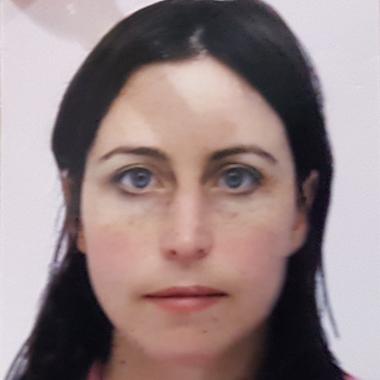
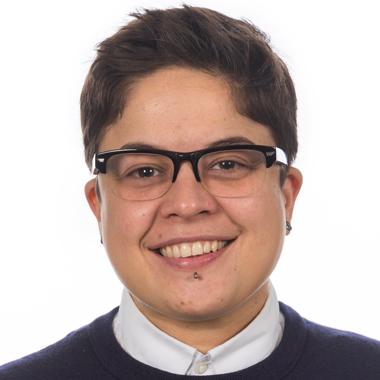
All staff on the programme are practising artists, curators and writers, here to respond to the work that you make and to help you understand how it contributes to – and challenges – the critical debates that exist in the study area and beyond.
Artists teaching studio practice include:
- Louise Ashcroft
- Becky Beasley
- Simon Bedwell
- Bonnie Camplin
- Ali Craighead
- Dr Nina Danino
- Paul Davis
- Ali Eisa
- Adham Faramawy
- Adam Gallagher
- Dr Laura Grace Ford
- Paul Jones
- Phillip Lai
- Bod Mellor
- Rachel Reupke
- Grace Schwindt
- Deniz Ünal
-
Bernard Walsh
- Dr Frank Wasser
- Annie Whiles
- Laura White
Researchers teaching critical studies inlcude:
- Dr Barby Asante
- Dr Vikki Chalkin
- Professor Stephen Johnstone
- Dr Susan Kelly
- Dr Nuria Querol
- Dr Sophie Sleigh-Johnson
- Dr Becca Voelcker
- Dr Lenka Vrablikova
- Dr Beny Wagner
- Dr Frank Wasser