MFA Creative and Life Writing
Content navigation menu
Why study MFA Creative and Life Writing at Goldsmiths
The MFA Creative and Life Writing is for committed writers who are interested in critically examining their own writing and exploring the possibilities of storytelling. Develop your writing skills within a challenging, flexible and advanced scheme of study, invigorated by current research.
- You may be writing regularly; you may be returning to it after concentrating on your career. Whatever your background, if you're serious about your writing, this postgraduate course can help you to develop your practice.
- Our students bring with them a lively range of interests, cultures and experiences. We welcome students of any age who share the drive to take their writing seriously.
- You’ll have the chance to experiment with different forms – poetry, the novel, short story and life writing – and to specialise in one of those areas, and you will receive expert guidance in each field. Read work by our students.
- The MFA programme builds on the MA Creative and Life Writing pathway by requiring you to gain knowledge of the professional context of the publishing industry, and by asking you to produce a book length piece of creative work.
- We host weekly readings and discussions organised by our Writers Centre, together with occasional visits from editors, literary agents and organisers of literary projects. Recent visitors include Booker Prize winner and creative writing alumni Bernardine Evaristo and acclaimed novelist and non-fiction writer Olivia Laing.
- Some seminars will be taken by visiting writers who will talk about their work, introduce you to different theories of creative writing and engage you in discussion about their writing. Recent visitors have included Ali Smith, Caryl Phillips, Claire Keegan and Daljit Nagra.
Contact
If you have specific questions about the degree, contact Tom Lee .
Length
2 years full-time or 4 years part-time
Entry requirements
You should have (or expect to be awarded) an undergraduate degree of at least upper second class standard in a relevant/related subject. You might also be considered if you have relevant experience and can show that you have the ability to work at postgraduate level.
School
Subject

We are an Adobe Creative Campus. During your studies, you will be able to use Photoshop, Premiere Pro, Illustrator and more for free on your own devices.
Watch videos about your course
What you'll study
Year 1
In your first year, you'll take three compulsory modules:
| Module title | Credits |
|---|---|
| Workshop in Creative and Life Writing | 60 credits |
| Contemporary Contexts for Creative and Life Writing | 30 credits |
| Specialist Workshop in an Aspect of Creative and Life Writing | 30 credits |
Assessments
You will be assessed in a range ways throughout your course. These will be both Formative (for feedback and development), and Summative (required to pass and progress to the next level). Summative assessments are compulsory.
Entry requirements
You should have (or expect to be awarded) an undergraduate degree of at least upper second class standard (or equivalent) degree in English or a related humanities/arts subject. You will also be required to submit a portfolio of creative writing.
Other qualifications of equivalent level to a degree are considered; as are degree results below the upper second class where there are indications of particular strength in this specialism. A high level of competence in written and spoken English is also required.
Students without BA-equivalent qualifications who have substantial work experience (e.g. in literary journalism, creative writing, publishing etc) may be considered.
International qualifications
We accept a wide range of international qualifications. Find out more about the qualifications we accept from around the world.
If English isn’t your first language, you will need an IELTS score (or equivalent English language qualification) of 7.0 with a 7.0 in writing and no element lower than 6.5 to study this programme. If you need assistance with your English language, we offer a range of courses that can help prepare you for postgraduate-level study.
Student work
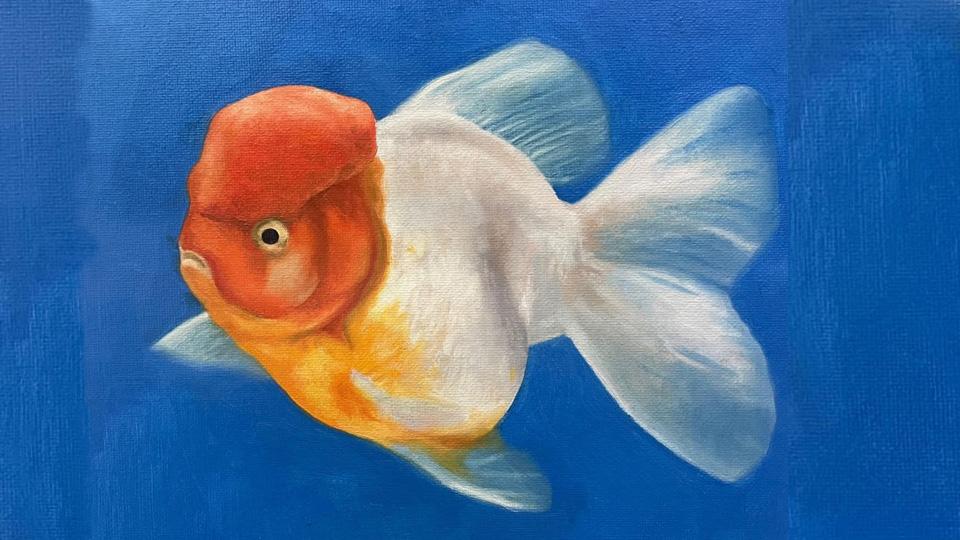
Take a look at Goldfish, an annual journal showcasing work by writers on the programme, including short stories, poetry and life writing.
Written, curated and published entirely by students, every year Goldfish showcases exciting new voices.
Pat Kavanagh Prize
Now in its 17th year, the £500 Prize commemorates literary agent Pat Kavanagh, who passed away in 2008.
The 2026 winner is Sophie García Halliday for ‘Edith Hendricks,’ an excerpt from an as-yet untitled novel about a food writer in 1960s New York and her relationship with her mother, who is a survivor of the German occupation of France during the Second World War.
The MA has been so valuable for me, not least because it gave me the time, space, and structure to focus on my writing. It’s probably been the most formative experience of my writing life.
Sophie García Halliday (MA Creative and Life Writing), winner of the Pat Kavanagh Prize 2026
How to apply
Apply directly to Goldsmiths using our online application system
Before submitting your application you’ll need to have:
- Details of your academic qualifications
- The email address of your referee who we can request a reference from, or alternatively a copy of your academic reference
- Copies of your educational transcripts or certificates
- A personal statement – this can either be uploaded as a Word Document or PDF, or completed online. Please see our guidance on writing a postgraduate statement
- You must also submit a portfolio of your creative or life writing with your application - see below for details
You'll be able to save your progress at any point and return to your application by logging in using your username/email and password.
Portfolio
You must submit a portfolio as part of your application. This can include two or three short stories, 12-20 poems, or several extracts from a novel. You can include a combination of genres in your portfolio to reflect your writing practice, with a mixture of short stories, poems, extracts from a novel or larger piece, and life writing.
There's no set word limit, but we'd recommend no more than 3,000 words of prose.
Please make sure portfolios are in 12pt font with double-line spacing.
When to apply
We accept applications from October for students wanting to start the following September. There is no fixed deadline for submitting your online application.
However, please note that due to the popularity of the programme and the large number of applications, places fill up quickly. We aim to process applications within three months of receipt of receiving your full application, including references. This may take longer during busier periods and holidays.
We encourage you to complete your application as early as possible, even if you haven't finished your current programme of study. It's very common to be offered a place that is conditional on you achieving a particular qualification.
If you're applying for funding, you may be subject to an application deadline.
Selection process
As part of the selection process, you may be invited to an online or in-person interview. Occasionally, we'll make candidates an offer of a place on the basis of their application and qualifications alone.
Find out more about applying.
Fees and funding
Annual tuition fees
These are the PG fees for students starting their programme in the 2026/2027 academic year.
If your fees are not listed here, please check our postgraduate fees guidance or contact the Fees Office, who can also advise you about how to pay your fees.
It’s not currently possible for international students to study part-time under a student visa. If you think you might be eligible to study part-time while being on another visa type, please contact our Admissions Team for more information.
If you are looking to pay your fees please see our guide to making a payment.
Funding opportunities
Use the Goldsmiths scholarships finder to find out what funding you may be eligible for.
Paying your fees
Find out about paying your tuition fees.
If you are a UK student you may be eligible for a postgraduate loan.
Meanwhile our Careers Service can also offer advice on finding work during your studies.
Additional costs
In addition to your tuition fees, you'll be responsible for any additional costs associated with your course, such as buying stationery and paying for photocopying. You can find out more about what you need to budget for on our study costs page.
There may also be specific additional costs associated with your programme. This can include things like paying for field trips or specialist materials for your assignments.
Careers
Where this degree can take you
Graduates from Literary and Creative Studies at Goldsmiths include writers Tom Lee, Lucy Caldwell, Ross Raisin, Amy Sackville, Evie Wyld, Sara Grant, Naomi Foyle, Joanna Quinn, Dizz Tate, Lisa Smith, Lijia Zhang, Elaine Castillo, Ashley Dartnell and Suzanne Joinson, the poets Emily Berry, Malika Booker, Nick Makoha, Jack Underwood, Abigail Parry, Anthony Joseph, Katrina Naomi, Rachel Long and Matthew Gregory.
Among them they've won or been shortlisted for awards including:
- Desmond Elliott Prize
- The Sunday Times/EFG Private Bank Short Story Award
- Rooney Prize for Literature
- Dylan Thomas Prize
- The Sunday Times Young Writer of the Year Award
- John Llewellyn Rhys Prize
- Eric Gregory Awards
- Guardian First Book Award
- New Writing Ventures Prize
- Betty Trask Awards
- The Miles Franklin Award
- The Encore Prize
- The Orange Prize
- The TS Eliot Prize
- The Costa Prize
- The Granta list of ‘Best of Young British Novelists’
Since 2018, seven of our graduates have been made fellows of the Royal Society of Literature.
Other graduates have gone on to work in publishing (for example, as senior commissioning editors), journalism, public relations, teaching, advertising, the civil service, business, industry, and the media.
Skills
The MFA will enable you to develop transferable skills, including: enhanced communication and discussion skills in written and oral contexts; the ability to analyse and evaluate different textual materials; the ability to organise information, and to assimilate and evaluate competing arguments.
Find out more about employability at Goldsmiths.