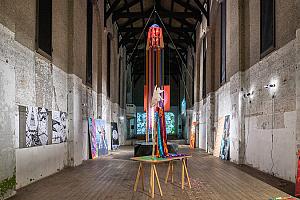
MRes Art*
Content navigation menu
Why study the Master of Research in Art at Goldsmiths
* This programme is still in development and advertised subject to validation. It is expected that the full programme specification will be available on this page no later than November 2026.
The Master of Research in Art is a groundbreaking programme designed for artists, writers and practitioners working in any media to prepare to undertake a sustained long-term body of research or project through studio-based practice.
- Art processes, materials, and contexts fuel the core dynamic of this programme. The course provides the opportunity to develop the material, spatial, performative, and experimental publishing dimensions of your research practice alongside each other.
- You will receive a dedicated studio space regardless of the medium in which you work. Writers will be allocated a space alongside artists and practitioners, which demonstrates a key approach of the programme: to challenge hierarchies between mediums.
- Your practice will be pushed to develop radical methods of questioning and inquiry. For example, through artistic perspectives that can be formed around making mistakes, not knowing, and tangents.
- You will establish your practice at its cutting edge by working directly with materials, objects, and subjects. Rather than creating distance and trying to remain objective, your ideas will develop through the process itself.
- Your research will not follow a fixed or linear path. Frameworks, starting points and questions will be formed by the experience and process of testing and making. You will be embedded within various discourses of art to further develop your approach.
- Throughout your studies, you will be challenged to fashion alternative strategies of generating findings outside of the question-answer binary.
Programme ethos
The programme aims to expand knowledge of the diversity and idiosyncrasy of art as a research process at this important moment, where research techniques are becoming more influential in contemporary art and where research councils are becoming more inclusive towards artistic research. We understand research to be a dimension of all contemporary art forms – sculpture, writing, installation, painting, performance, video, etc.
Art research methods are distinct from those across the social sciences. The strength of this programme is how it immerses you into the world of contemporary art research through your own practice.
As Michael Sheringham describes artists’ distinguished use of the project format: “The project is not designed to achieve a particular end, but to allow something unforeseen to happen.”
Contact
If you have specific questions about the degree, contact Dr Joseph Noonan-Ganley .
Length
1 year full-time, or 2 years part-time
Study mode
In-person
Entry requirements
A second-class standard degree in a related subject area or equivalent professional experience.
School
Subject

We are an Adobe Creative Campus. During your studies, you will be able to use Photoshop, Premiere Pro, Illustrator and more for free on your own devices.
What you'll study
Teaching activities emerge from and build upon the heritage of rigorous student-centred art pedagogy within the School of Art at Goldsmiths.
Through tutorials, collective forums, lectures and research methods workshops, you will produce a self-directed body of contemporary art research, supported by textual exposition and proposal writing.
You will be encouraged to take artistic risks, to challenge established norms of making, and will be supported to be inventive, playful and imaginative with technical processes, contexts and strategies of presentation.
You will learn to critically situate your work in relation to historical and contemporary art research practices and discourses, as well as fashioning and exploring new techniques and insights.
You will learn to write a research proposal, where you acquire research application and PhD proposal writing skills, which will help you translate and articulate your practice for Arts Councils and UKRI funding schemes.
The curriculum is designed to provide access to research terminology used by all the major UK research funding councils and organisations such as Arts Council, AHRC, ESRC, The Wellcome Trust, British Academy, and Leverhulme Trust.
There are non-assessed collaborative workshops run with the MA Creative & Life Writing programme and the Research Knowledge Exchange department at Goldsmiths.
Assessment
Facilities
The material and technical production of your research will be supported by Art Practice Tutors who possess specialist knowledge across the School's eleven Art Practice Areas:
- Constructed Textiles
- Fine Art Print
- Graphics and Time-Based Media
- Photography
- 3D Printing
- Casting and Mould-Making
- Ceramics
- Metal
- Woodwork
- Stitch and Fabric
- Textiles Print and Dye
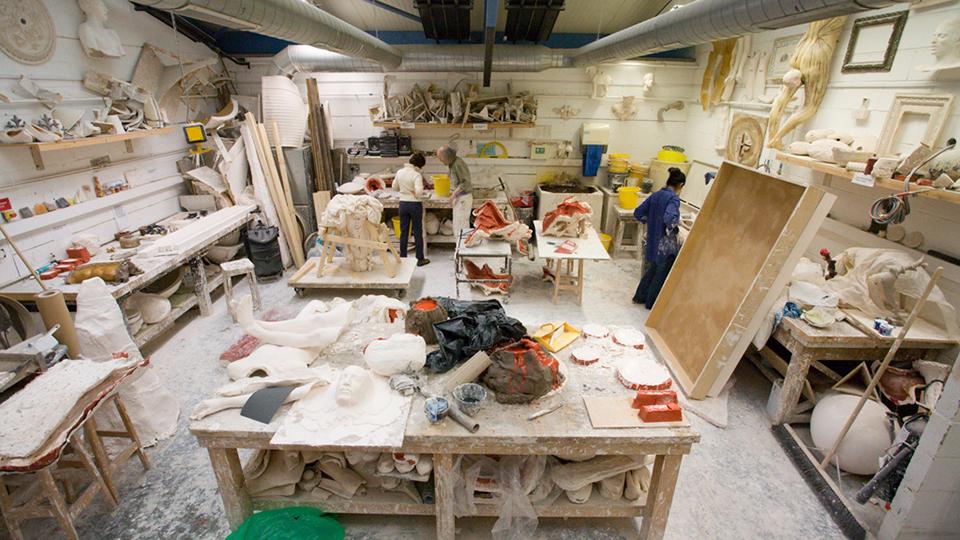
You'll be able to get to grips with art practice areas including casting, metal, print and dye, and fine art print.
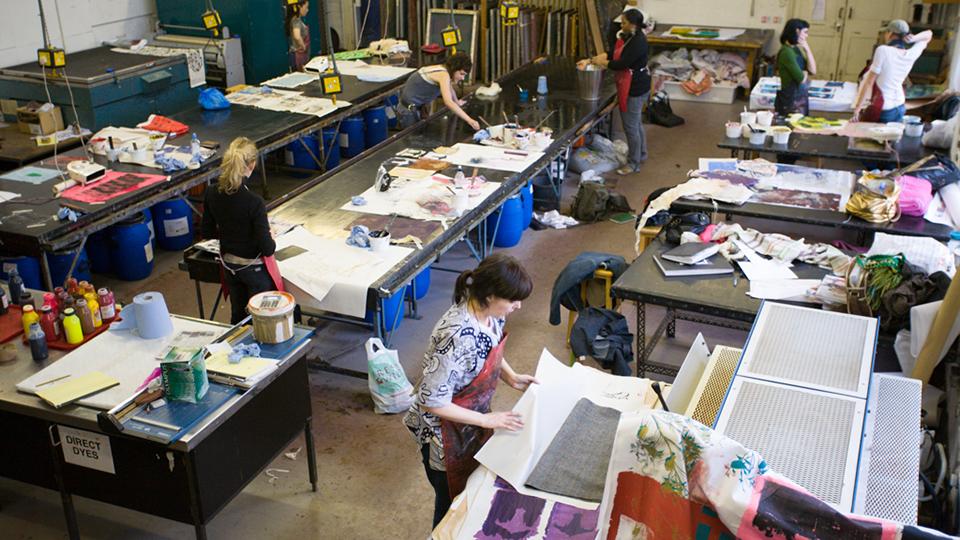
The degree will support your development and creativity, and help you acquire technical and independent learning skills.
Entry requirements
You are expected to hold a BA or higher in Art or Art History/Theory or a related subject area with a minimum second-class standard.
We will also consider applications from those with a track record of closely related professional practice demonstrating equivalent levels of expertise.
International qualifications
We accept a wide range of international qualifications. Find out more about the qualifications we accept from around the world.
If English isn’t your first language, you will need an IELTS score (or equivalent English language qualification) of 6.5 with a 6.5 in writing and no element lower than 6.0 to study this programme. If you need assistance with your English language, we offer a range of courses that can help prepare you for postgraduate study.
The application process
Please note: This programme is subject to validation, the following steps are to provide guidance once applications open.
Sign up to be informed when applications open.
How to apply
To complete your application, you will need to have:
- One page of text describing your current practice
- One page of text describing the work you want to explore on this programme. This should address the techniques, materials or subjects you are interested in
- A portfolio of past work (30 pages limit, save as a PDF)
- Details of your education history, including the dates of all exams/assessments and copies of your certificates
- The email address of your referee who we can request a reference from, or alternatively an electronic copy of your academic reference
When to apply
Pending final course approval, applications will be open in November 2026.
In the meantime, for any questions, please contact Joseph Noonan-ganley.
Further guidance
Read our guide to applying for a postgraduate degree at Goldsmiths.
Fees and funding
Annual tuition fees
These are the PG fees for students starting their programme in the 2026/2027 academic year.
If your fees are not listed here, please check our postgraduate fees guidance or contact the Fees Office, who can also advise you about how to pay your fees.
It’s not currently possible for international students to study part-time under a student visa. If you think you might be eligible to study part-time while being on another visa type, please contact our Admissions Team for more information.
If you are looking to pay your fees please see our guide to making a payment.
Funding opportunities
Explore the Goldsmiths scholarships finder to find out what funding you may be eligible for.
If you are a UK student you may be eligible for a postgraduate loan.
Meanwhile our Careers Service can also offer advice on finding work during your studies.
Paying your fees
Find out about paying your tuition fees.
Additional costs
In addition to your tuition fees, you'll be responsible for any additional costs associated with your course, such as buying stationery and paying for photocopying. You can find out more about what you need to budget for on our study costs page.
There may also be specific additional costs associated with your programme. This can include things like paying for field trips or specialist materials for your assignments. Please check the programme specification for more information.