Pattern Library
This is our interactive collection of designs and layouts, patterns, slices and components with the view to making these available. It is a living document and these guidelines keep changing, accordingly.
Primary page content
1. Pattern Library: introduction
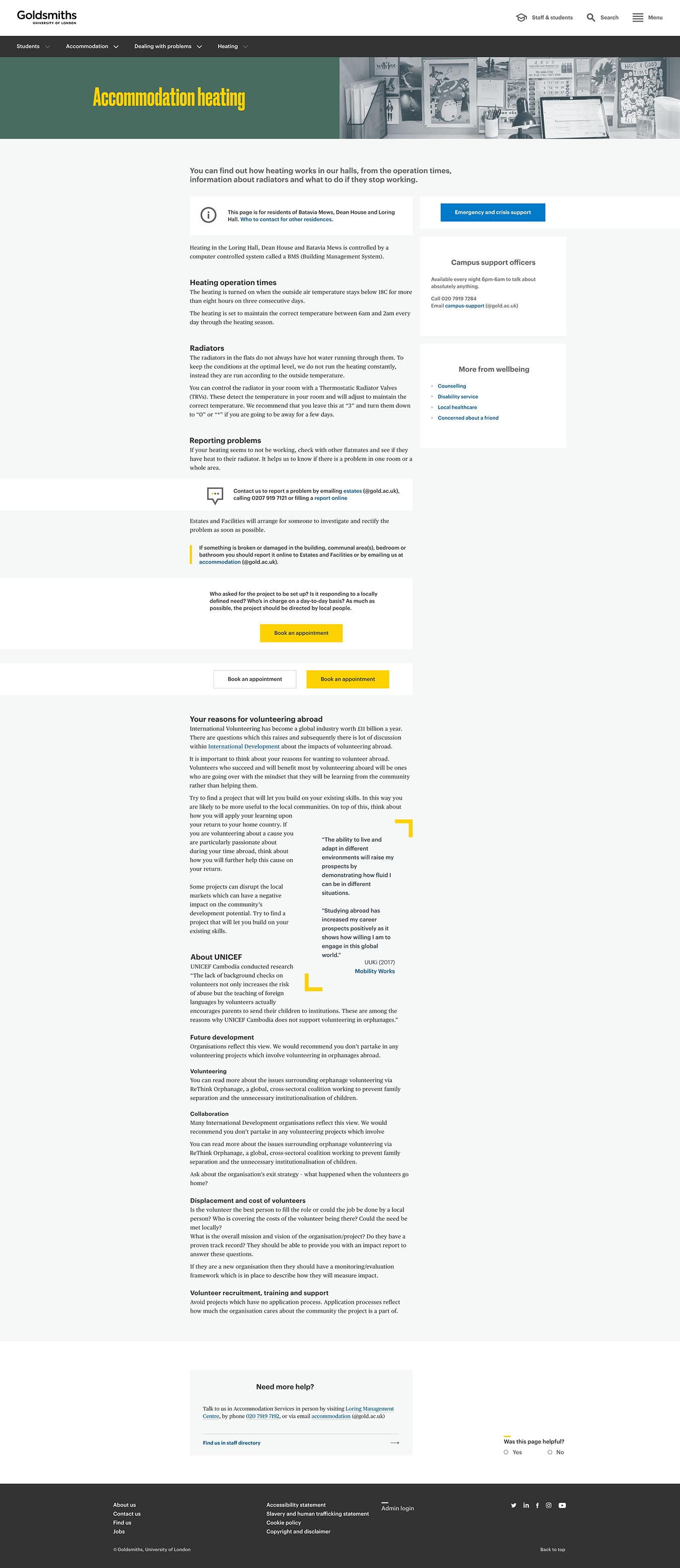
Existing gold.ac.uk 'general pages' include a broad family of webpages ranging from a departmental page about reasearch, to an accommodation page about heating, or a library page about special collections or even (with some minor variations) a news story. In summary, a general page is our most used and versatile template, fulfilling a myriad of different purposes:
- Art Department's About page
- Theatre and Performance's Research section
- Library's Special Collections section
- Sound of happy - News story page
Why changing?
gold.ac.uk was launched in October 2015. We achieved a few accolades: HEIST awards 2016 - winner Best Higher Education Website 2016 (#1); BIMA (British Interactive Media Association) - shortlisted in two categories: Education and Web Design & Build; DADI (Drum Awards for the Digital Industries) - shortlisted in one category: UX / Usability.
However these are no reasons to keep still as landscape around us keeps changing; three years and a half in digital terms is a long time. Mainly, the pattern library work is to directly contribute to improving the student experience and will affect how people outside Goldsmiths access information about us - whether they're a prospective student, a journalist, or a member of the public looking to attend an event.
The pattern library project started in October 2018 on the back of the general page brief, with first changes launched in July 2019, to give an idea of timescale.
2. Pattern Library: principles
Accessibility, readability and warmth have been the core focus of all our UX Design improvements. Everything you will see here was created with these three principles in mind. If you think of something in relation to these, please let me know.
Accessibility
It’s about removing barriers and being inclusive. It can be achieved in a number of ways such as by including alternative text in images for screen readers, allowing font and content to be adjusted by users themselves (using relative units instead of pixels), paying attention to colour contrast, structuring web pages with correct semantics, and so on and so forth... [aside: WCGA 2.1]
Readability
It’s the degree to which prose can be understood, based on the complexity of words and sentences. Complex information requires the simplest presentation possible, so that the focus is on the information rather than the way it is presented. Readability is greatly affected by visual clarity of text (legibility) with things such as size, typeface, contrast, spacing of characters and line width playing an important role. [aside: People read on the web in different ways either to scan for something particular, to focus in engaged reading, or in some form of casual reading.]
Warmth
We know when we feel warm.
3. Pattern Library: guidelines
Accessibility, readability and warmth
- Layout
- Colour
- Typography
- Iconography
- Reference [PDF]: William Lidwell, Kritina Holden, Jill Butler - Universal Principles of Design
- Research [online]: w3.org/WAI/fundamentals/accessibility-principles/
Users on the go
Layout: supporting and related content
Layout: no 2nd column
Typography: headings
Typography: links
- Example #1
- Research [online]: nngroup.com/articles/clickable-elements/
- Implications for UX Design - Professional services
- Implications for UX Design - Study
- Implications for UX Design - Homepage
- Homepage keyboard interaction for accessibility
- Homepage menu keyboard interaction for accessibility
4. Pattern library: patterns showcase
Information standout and calls to action (CTAs)
- Highlight
- Information or alert notice standout
- Emergency and crisis support
- Button with variations
- Download
- Contact
- Read
- Go to... and Report
- Question
Calls to action (CTAs) with forms, error handling, and success message
- Research [online]: nngroup.com/articles/required-fields/
- Research [online]: nngroup.com/articles/errors-forms-design-guidelines/
- Standard space
- Enhanced general page space
- 50/50 hero
Images, video, photo gallery and other slices
Quote (framing words)
Side box
5. Pattern Library: UX Design testing for accessibility, readability and warmth
Usability testing (readability and warmth) methodology
- Information sheet
- Consent form
- All documents [PDF]
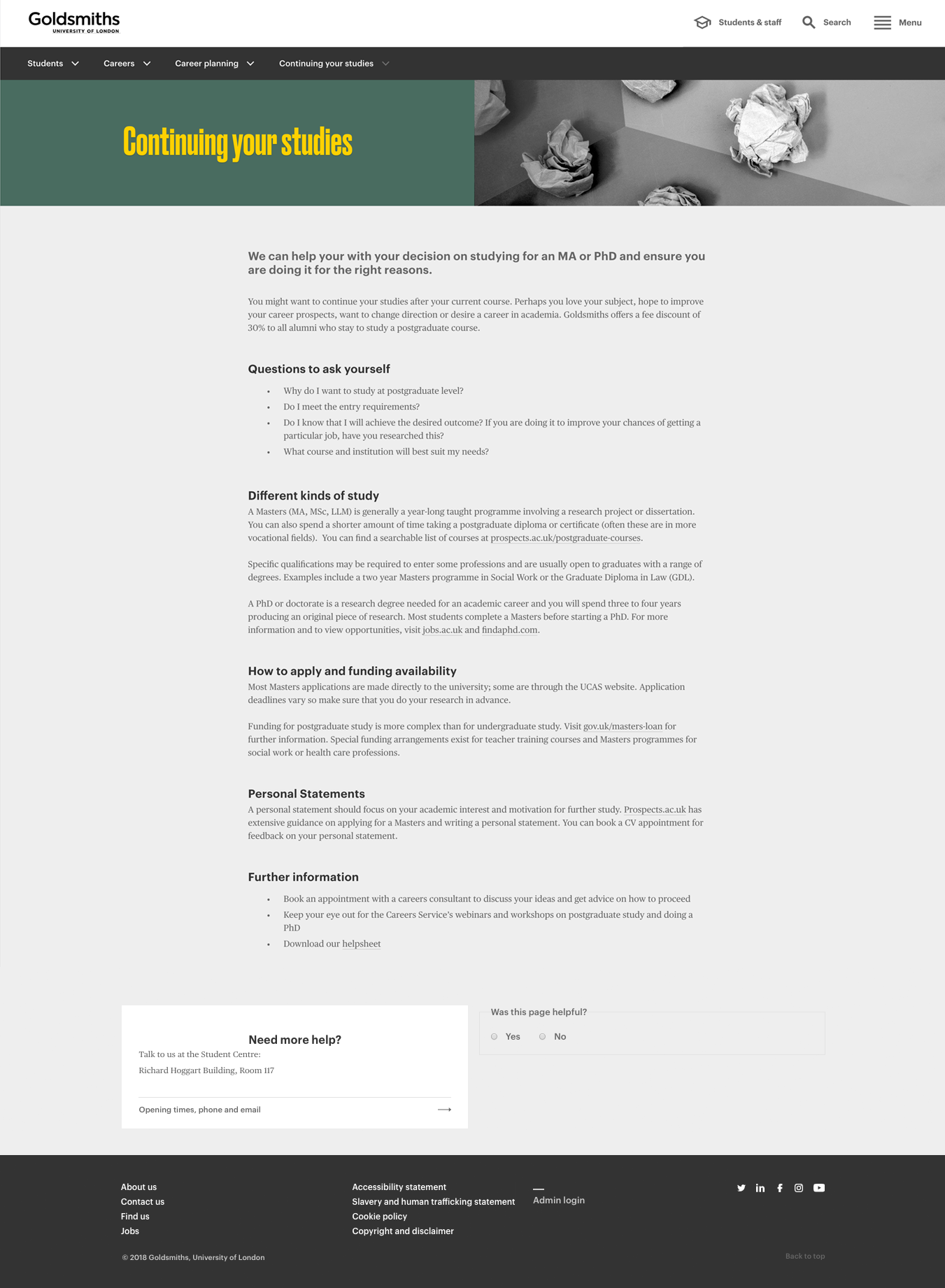
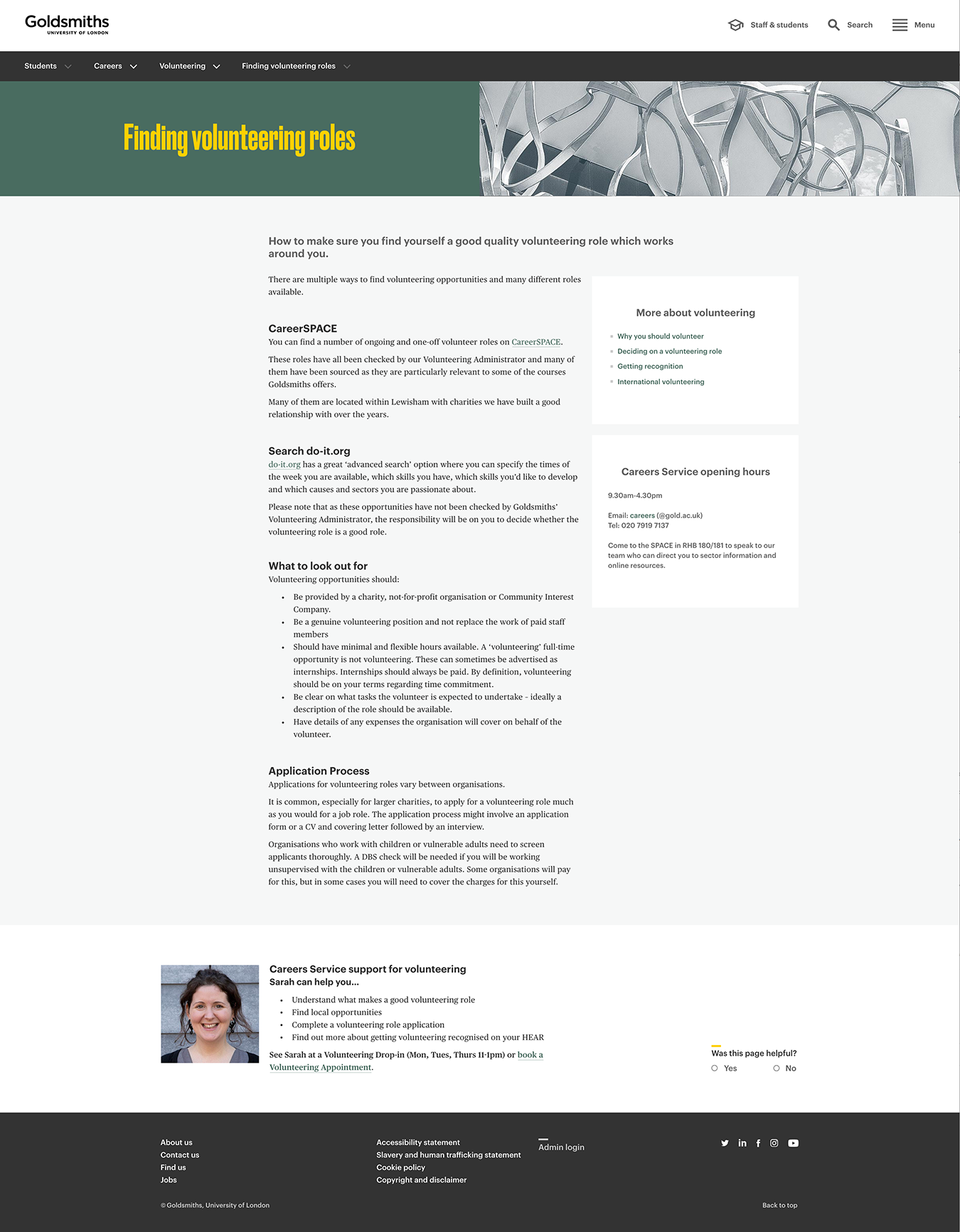
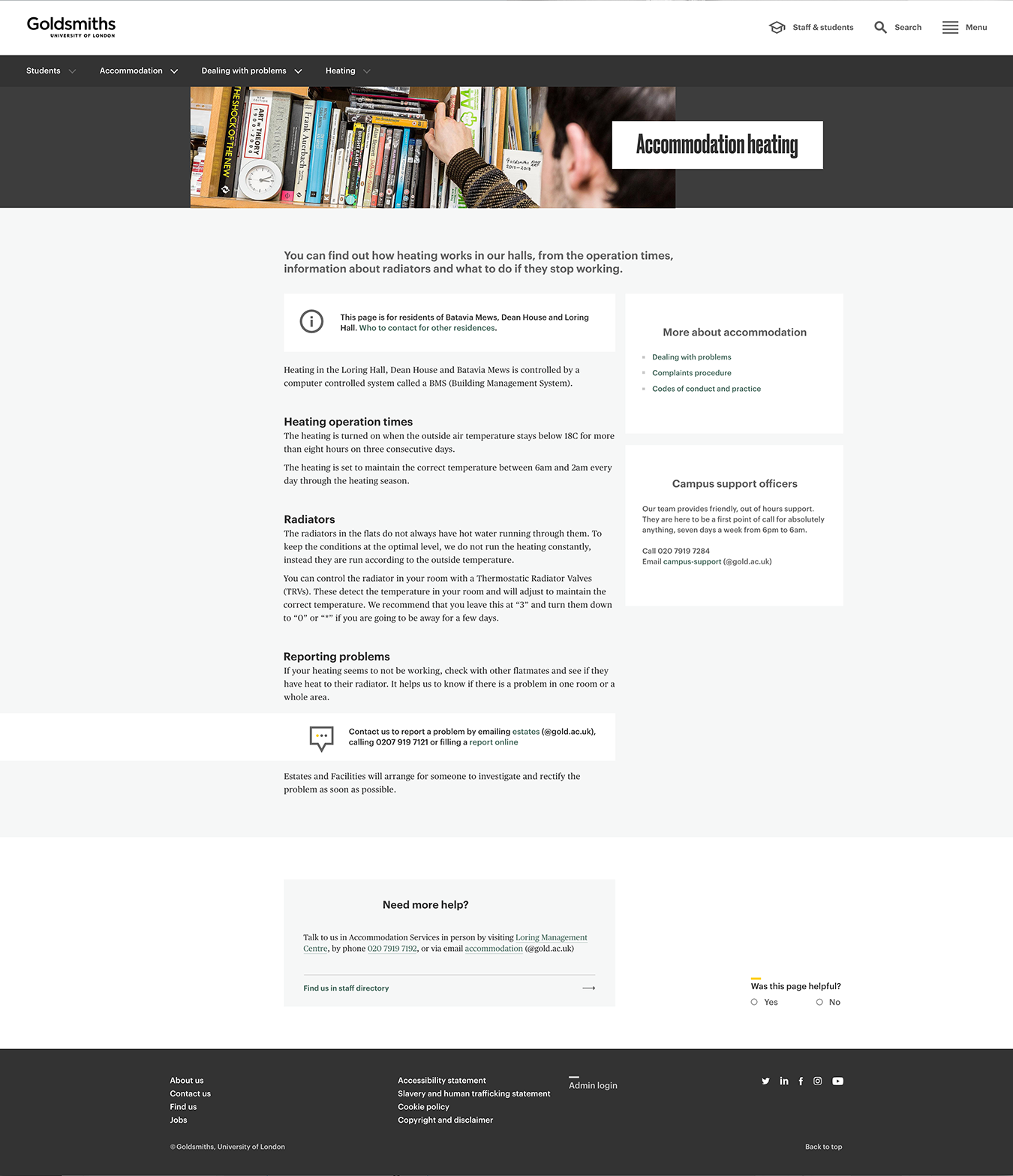
Designs for usability testing: first five participants
- Route A [current design]: gold.ac.uk/careers/planning/continuing-your-studies/
- Route B prototyped page for testing: gold.ac.uk/careers/volunteering/finding-roles/
- Route B prototyped page for testing: gold.ac.uk/students/accommodation/problems/heating/
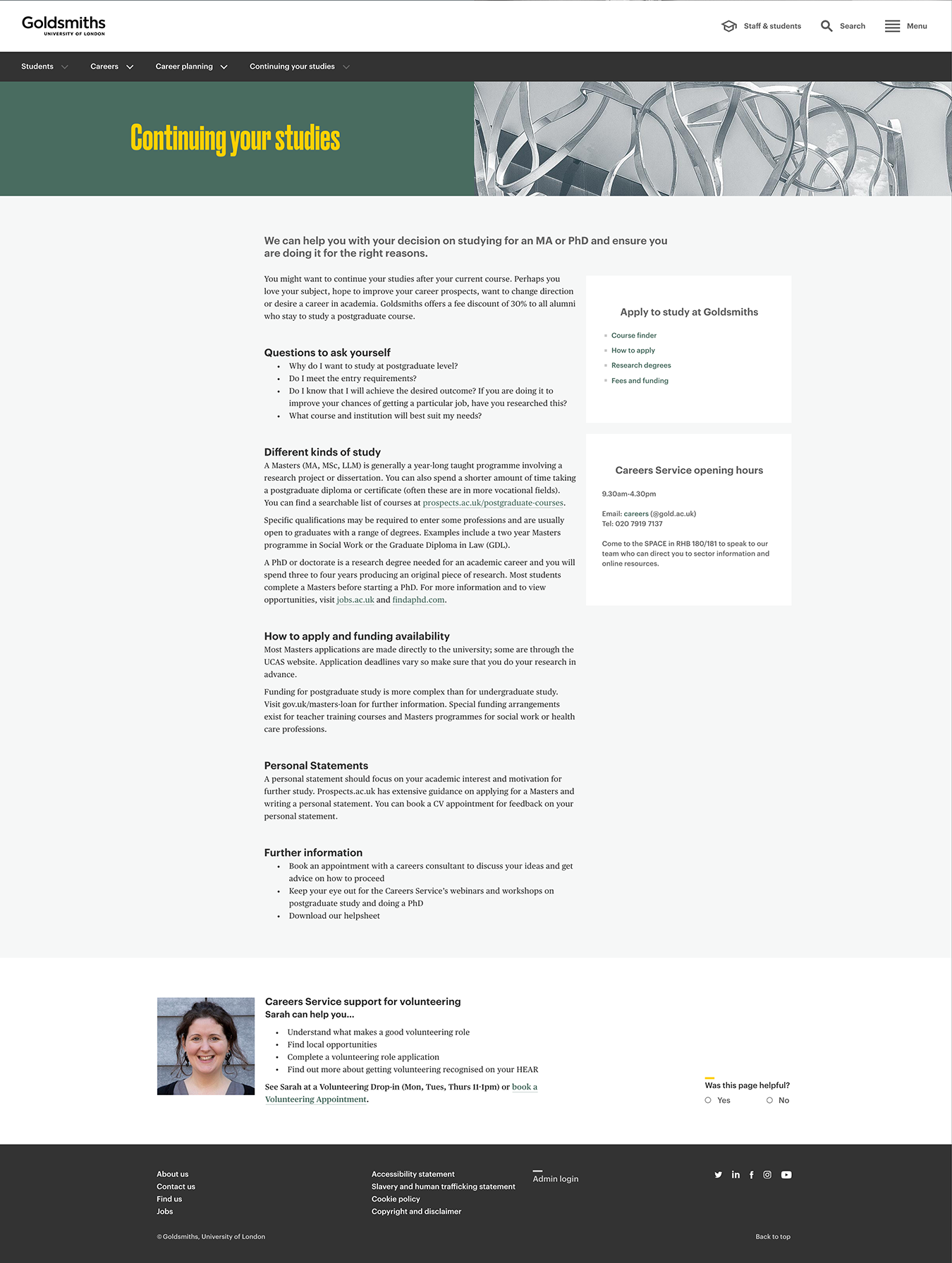
Designs for usability testing: second five participants
- Route B prototyped page for testing: gold.ac.uk/careers/planning/continuing-your-studies/
- Route A [current design]: gold.ac.uk/careers/volunteering/finding-roles/
- Route B prototyped page for testing: gold.ac.uk/students/accommodation/problems/heating/
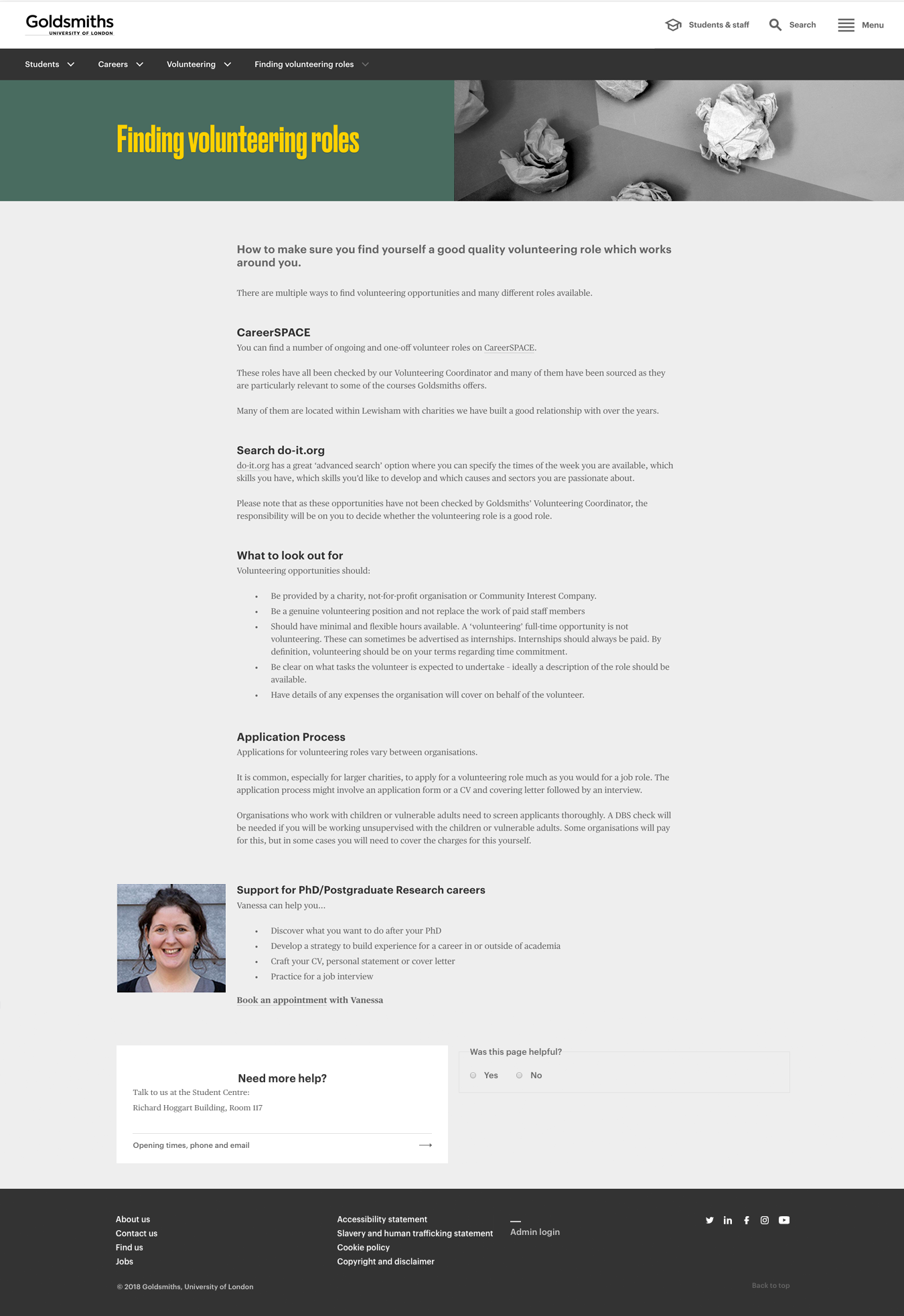
Evaluation report - 1st round of testing: Please contact us to find out more about the findings
DigInclusion prototypes for accessibility testing
- Route A prototyped page for testing: Prototype#1
- Route A prototyped page for testing: Prototype#2
- Route B prototyped page for testing: Prototype#3
- Route B prototyped page for testing: Prototype#4
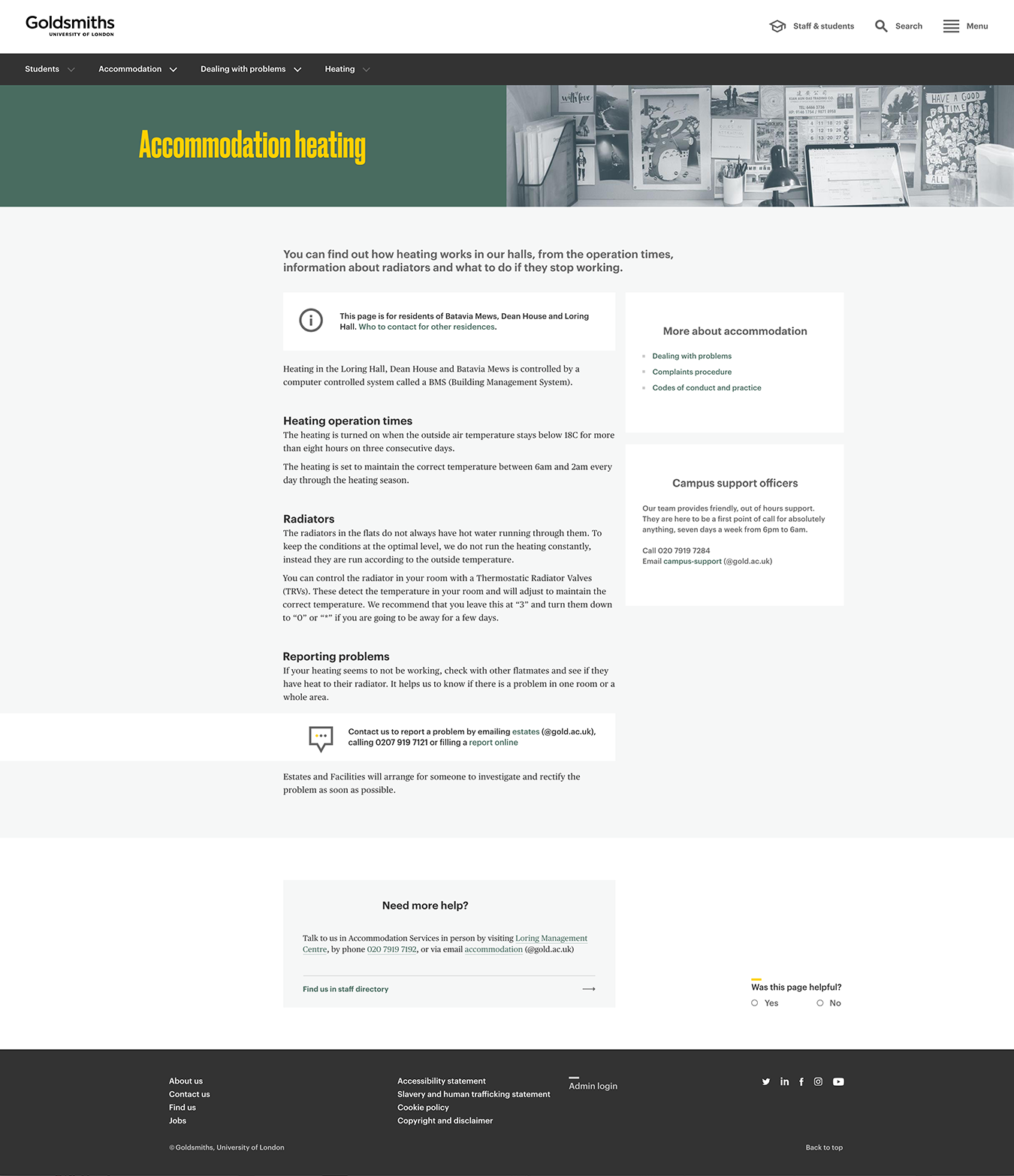
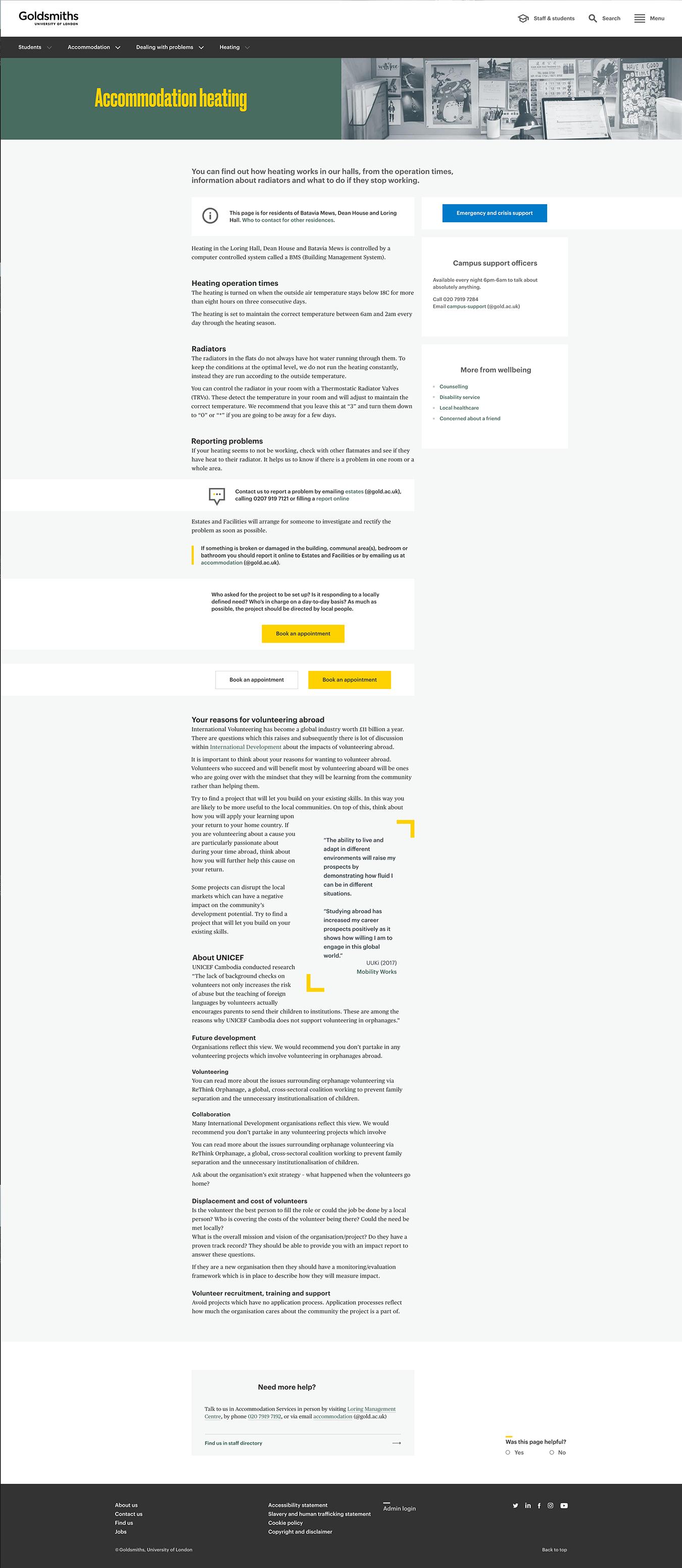
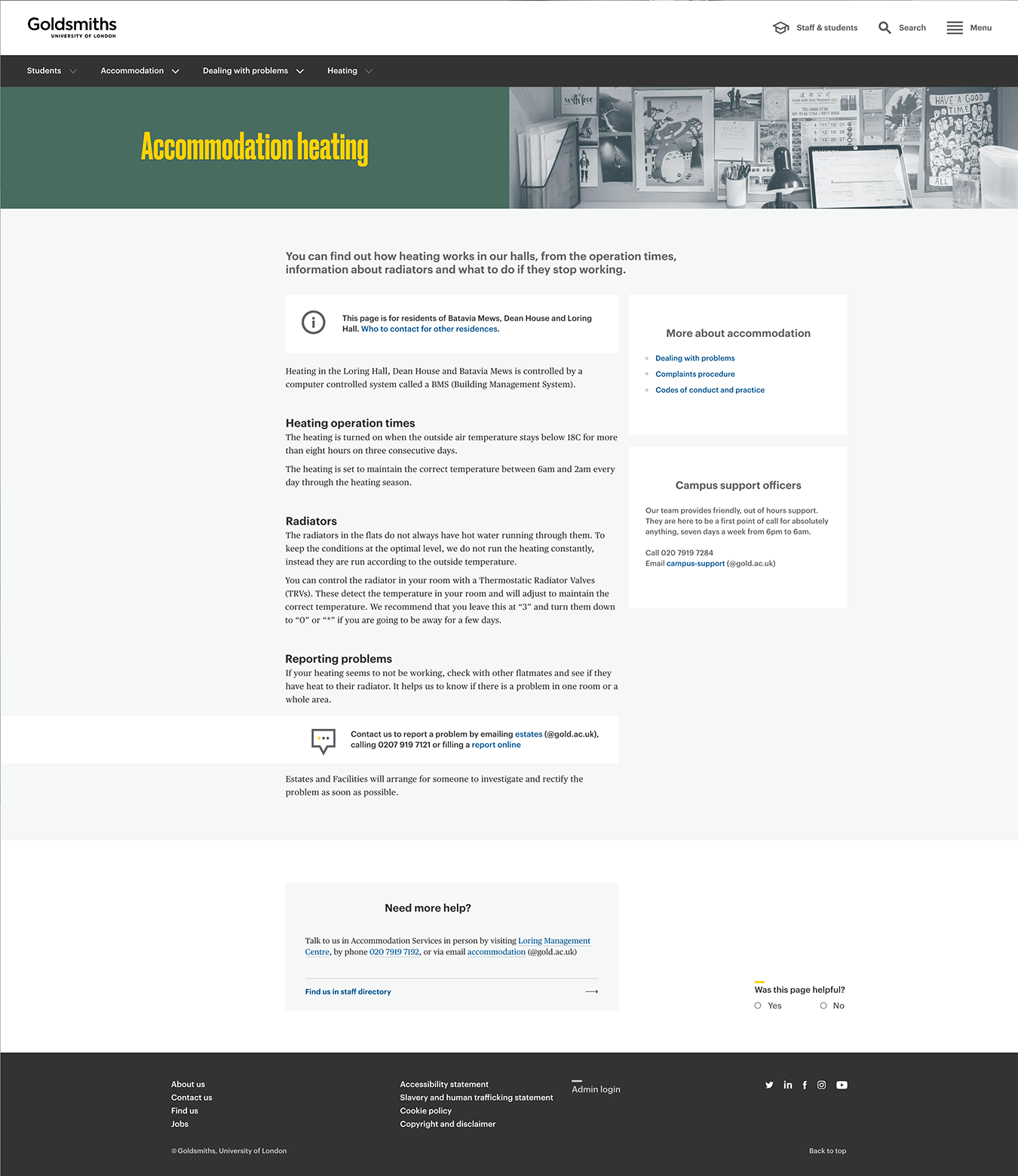
Evaluation report by DigInclusion - 2st round of testing: DigInclusion Report [PDF]
6. Pattern Library: previous research
Numiko's user research with full information from five personas (Aug, 2014) [PDF]
- Leila: Current student, Masters
- Lynda: Parent (Influencer)
- Hua: Prospective International, Masters
- Tamina: Prospective London-based, Masters
- Jack: Prospective non London-based, Undergraduate
7. Pattern Library: design specs
Project link [XD]: xd.adobe.com/spec/4862caf7-062c-4972-b49e-f9a25cc71f39-1d31/grid
Project link [Zeplin]: app.zeplin.io/project/5c376480bbe14e29b6e76b8c/dashboard