Forensic Architecture analysis uncovers alleged human rights abuses by Egypt
Primary page content
A new analysis by Goldsmiths-based research agency Forensic Architecture (FA) has uncovered alleged human rights abuses by the Egyptian military, including evidence of a mass grave used for civilians.
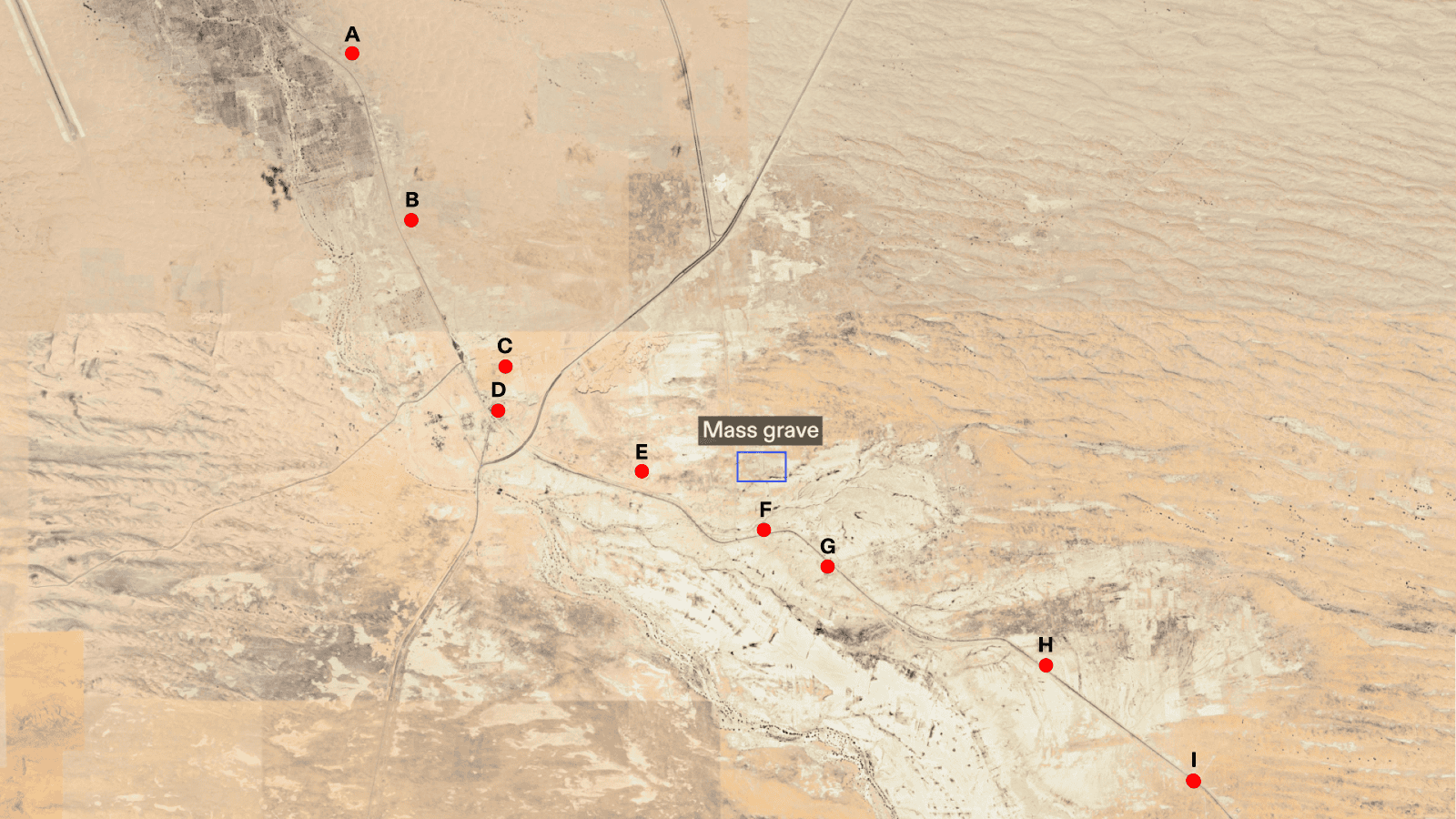
Annotated satellite image showing military outposts in North Sinai near the location of the mass grave. External image source: Google Earth. (Forensic Architecture, 2025)
The interdisciplinary research agency reviewed information collected by the Sinai Foundation for Human Rights (SFHR), which reveals a mass grave likely used by the Egyptian military for civilian victims of their campaign against ISIS-affiliated militants in North Sinai from 2013 to 2019.
Following the publication of these reports, SFHR will deliver an oral statement at the Human Rights Council in Geneva on 23 Sept 2025.
Since 2013, the Egyptian military has been accused of committing human rights violations against the civilian population of North Sinai, during its campaign against ISIS-affiliated militants in the region.
Working with satellite imagery and documentation gathered during field research by SFHR, FA examined a suspected mass grave site.
Findings include:
- 36 human skulls were documented in visual evidence captured at the site. However, reports by SFHR suggest that the total number of bodies is significantly higher, with numerous remains unaccounted for
- The most significant activity in the site, marked by multiple tire tracks directly in the pits from vehicles that are likelymilitary or military-affiliated, occurred during the peak of the military's campaign between 2015 and 2017
- Between 2013 and 2016, new military infrastructure was established in the surrounding the site and existing civilian infrastructure was demolished and cleared, suggesting military control of the area. This control, coupled with the imposition of strict military curfews starting in 2014, makes it unlikely that any non-military actors could have accessed the site regularly, let alone bury bodies, without being observed or challenged
Taken together, Forensic Architecture believes increased militarisation of the area and the regular presence of vehicles that are likely military or military-affiliated suggests that the Egyptian military is not only aware of the presence of human remains on the site but is likely responsible for the presence of those remains.
This extensive body of research by SFHR, towards which our analysis contributes, reinforces our understanding of how the Egyptian military commits gross human rights violations, and seeks to erase the evidence. International pressure must be brought to bear to demand a full and transparent investigation of the circumstances of the mass grave site we have identified.
Forensic Architecture researcher
FA is an independent research agency based at Goldsmiths, with a mandate to develop, employ, and disseminate new techniques, methods, and concepts for investigating state and corporate violence. The team includes architects, software developers, filmmakers, investigative journalists, scientists, and lawyers.
It is an interdisciplinary agency operating across human rights, journalism, architecture, art and aesthetics, academia and the law. In 2022, the Peabody Awards programme wrote that we had co-created ":an entire new academic field and emergent media practice”. In 2024 the European Research Council assessed FA as “a scientific breakthrough (defined as a revolutionary work that led to deep change in existing paradigms or new methods opening a new stream of research)".