From cell to stage: Tell Me if I’m Guilty confronts gendered injustice through co-created theatre
Primary page content
Compelling new theatre piece co-created with incarcerated women and Goldsmiths’ Open Book programme exposes the lived realities of young women caught in the criminal justice system.
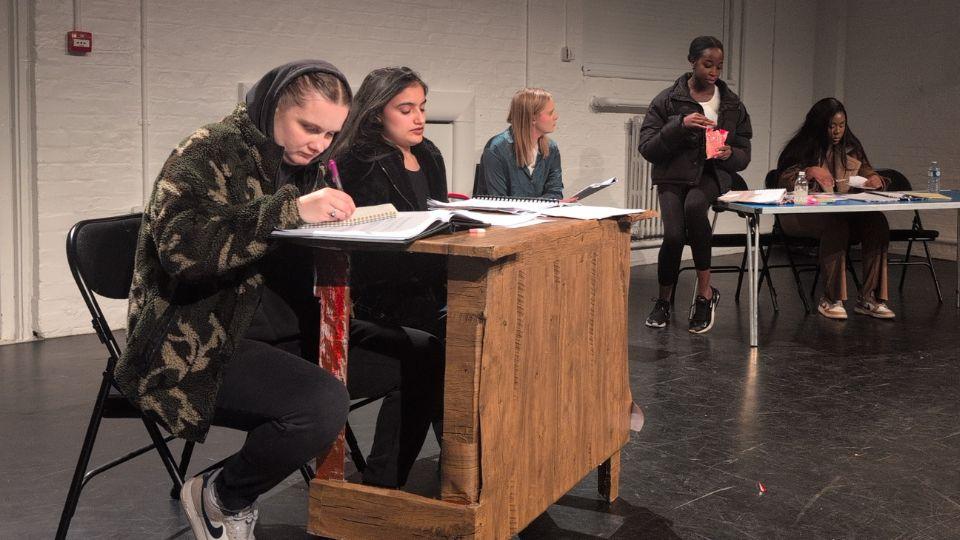
Bringing the young women of HMP Downview to the stage - from l-r, Ro Florence (Iz), Roxanne Ashdown (Renee), Susannah Gale (Sam, Facilitator), Anna-Maria Nwosu (Starr) - MA Applied Anthropology and Community Development, Goldsmiths and Peace Oseyenum (Storm)
From cell to stage
A powerful new performance, Tell Me if I’m Guilty, led by Goldsmiths Open Book, has been created in partnership with young women from women’s prison, HMP Downview. The work illuminates both the gendered injustices at the heart of the UK justice system and the transformative potential of co-created theatre.
Rooted in Open Book’s approach, where people with lived experience retain authorship, narrative power, and control over how their stories are told, the piece was developed by the women in collaboration with Clean Break, the theatre company that works with women affected by the criminal justice system.
The project was supported by Clean Break practitioner Laura Asare, who collaborated closely with the women throughout the development process. Goldsmiths MA Applied Theatre: Drama in Education, Community & Social Contexts graduate Jenn Bemis, the piece's director, contributed to a series of workshops as part of her placement, later shaping the classroom scenes based on her time inside. Jenn made return visits to the prison to share drafts for creative feedback and joined the cast for a final read-through as the piece came together.
The performance was brought to life by a cast of professional actors and talent from our BA (Hons) Drama & Theatre Arts with Acting.
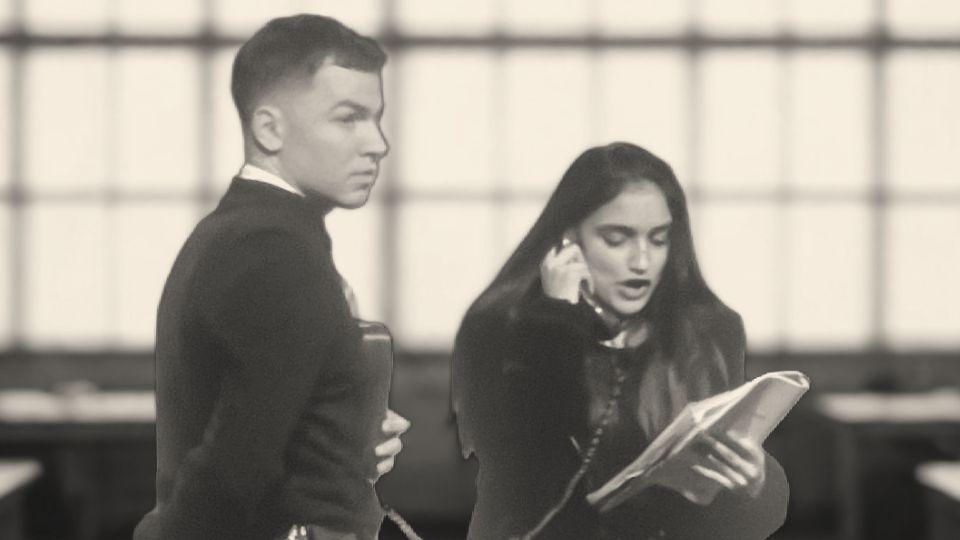
Actors bring to life the young women of HMP Downview, portraying their stories with honesty and emotional depth in Tell Me if I’m Guilty. Oleksii Lytvyn (Guard) - BA Drama and Theatre Arts, Goldsmiths with Roxanne Ashdown (Renee)
Co-creation at the heart
Their intention was clear: to make visible the experiences of women who are often unheard, misrepresented, or erased altogether.
Working through Open Book’s ‘author-led’ methodology, the young women directed the emotional tone, narrative structure, and characterisation themselves, ensuring the final performance honoured their intent and remained accountable to their lived experience.
Tell Me if I’m Guilty also vividly captured their aspirations to engage in education, explore their potential, and pursue opportunities rarely available within the traditional education system.
Criminalised rather than protected
Across the performance, the young women’s voices rang out with clarity and force, particularly in their critique of Joint Enterprise, the controversial legal doctrine under which individuals can be convicted of serious crimes, including murder, on the basis of association rather than direct action.
One of the aims of the creators of Tell Me if I’m Guilty, is to reveal the traps and situations many of them have found themselves in - coerced relationships, grooming, fear, survival strategies, and years of violence at the hands of men. The women depicted spoke about how, even when acting in self-defence or under extreme duress, they were criminalised rather than protected; how their lack of choices was misread as consent; and how Joint Enterprise has swept countless women into life sentences for acts they did not commit.
Tell Me if I’m Guilty aims to trace these dynamics with unflinching honesty, showing how patriarchal systems not only fail women but categorically misinterpret their behaviour, histories, and vulnerabilities.
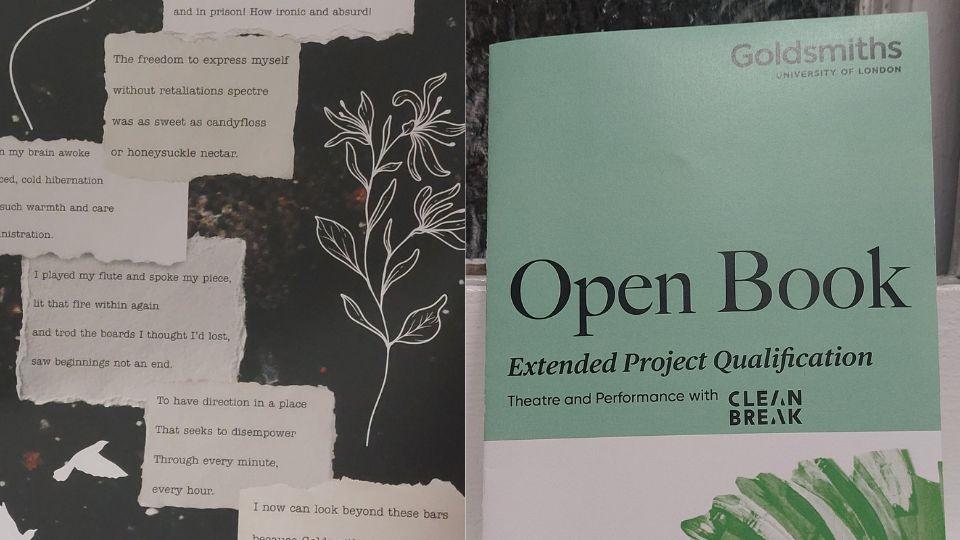
The audience were welcomed into a space enriched with project displays, offering insight into the Open Book EPQ and its collaboration with Clean Break
Education and aspiration
Tell Me if I’m Guilty is part of Goldsmiths’ Open Book’s wider mission: to challenge stigma, open up space for dialogue, and support communities in telling their own stories with dignity and agency.
Through this model, students and participants build trust, develop skills, and collaboratively craft work that pushes audiences to confront the conditions that criminalise women.
The performance also aimed to highlight the women’s educational ambitions, showing how Open Book provides pathways to learning and personal development that are rarely available within conventional educational structures.
Not only what it told, but how it was made…
Tell Me if I’m Guilty wove the Open Book methodology into the narrative itself, depicting the collaborative, author-led creative process at the heart of the programme.
Scenes showed negotiation of voice, trust-building, ethical decision-making, and the collective shaping of story, allowing audiences to witness both the finished work and the method that produced it.
Knowledge in action
For all the participants, including Goldsmiths students, the project offered an immersive learning experience in trauma-informed practice, participatory theatre, and ethical co-creation, key pillars of the Open Book model. It also demonstrated theatre’s crucial role in building public understanding of social harm and amplifying voices too often marginalised by mainstream narratives.
The collaboration with Clean Break, the UK’s leading theatre company working with women affected by the criminal justice system, further grounded the work in decades of feminist, abolitionist, and justice-centred practice.
Acknowledging support
We are grateful to the Goldsmiths Foundation for their generous funding, which makes initiatives like Open Book possible and enables projects that open up pathways to education and creative opportunity for people from marginalised backgrounds.
“Since 2001, 300 students from working-class and diverse backgrounds have gone on to undergraduate and postgraduate study, and programmes like this can literally save lives by offering a route to a better reason for living."
Joe Baden, OBE, Director, Open Book
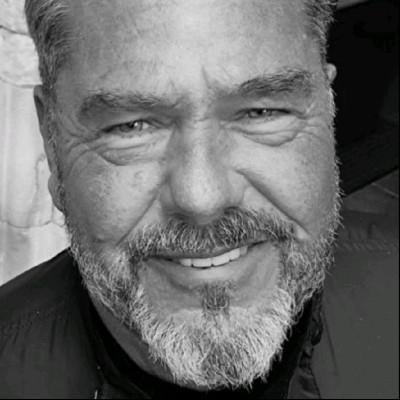
“Since 2001, 300 students from working-class and diverse backgrounds have gone on to undergraduate and postgraduate study, and programmes like this can literally save lives by offering a route to a better reason for living.
Goldsmiths Open Book, and projects like tonight’s performance, are needed more than ever to protect access to education, critical thinking, and self-determination in the face of inequality and social barriers.”- Joe Baden, OBE, Director of Open Book, Goldsmiths
Find out about how Goldsmiths is working to dismantle barriers to higher education, offering free, open-access classes, creative and academic skills training, pastoral support, and routes to university: Open Book