MA marks 30 years of shaping arts and cultural policy
Primary page content
Graduates, students, staff and industry partners have celebrated the 30th anniversary of our MA Arts Administration and Cultural Policy, a programme which emphasises the political and ethical dimensions of the arts and cultural sector.
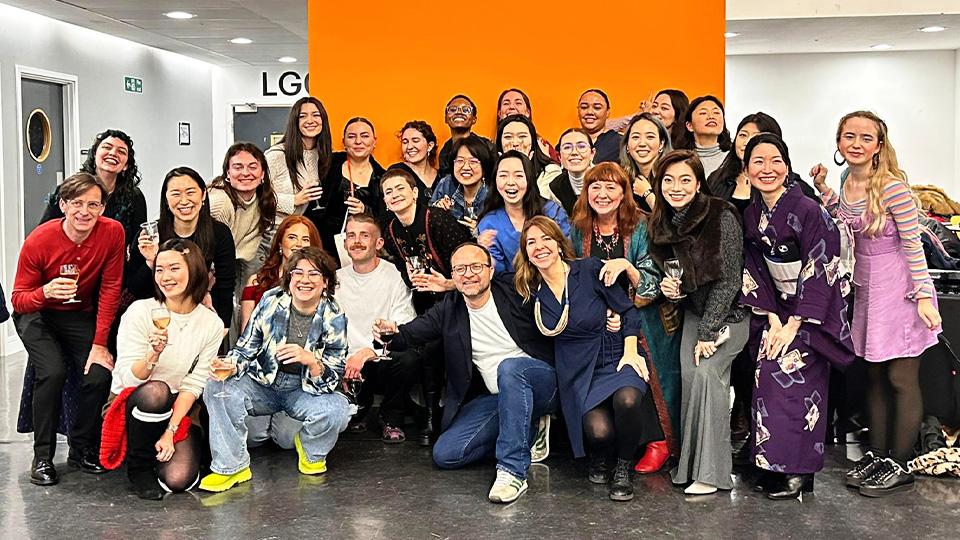
Party time: attendees mark the programme's 30th anniversary
More than 100 friends and supporters gathered on campus and online to recognise the anniversary of the programme which was created in 1995 as part of the Institute for Creative and Cultural Entrepreneurship and is now part of the School of Creative Management.
Founder Gerald Lidstone led the celebrations alongside current programme co-directors Dr Aleksandar Brkić and Dr Cecilia Dinardi.
The event heard how core staff joined academia from industry after successful collaborations in the early days of the programme, such as Karla Barnacle-Best, Jonathan Meth, Dr Carla Figueira, Rod Fisher, Insub Song, Maria Georgouli Loupi, Dr Tricia Jenkins, and Dr Sylvia Lahav.
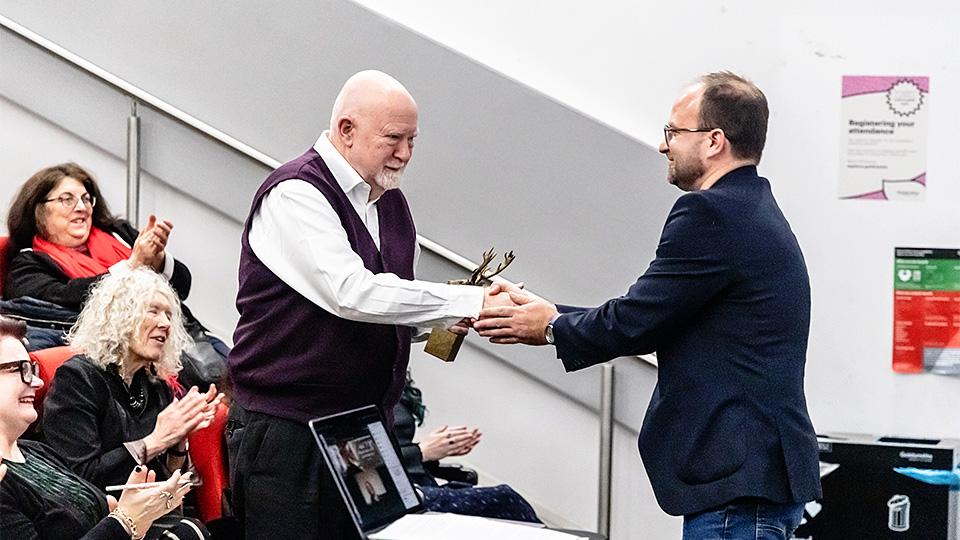
Shake on it: Gerald and Dr Brkić
‘The future of the creative industries will be international’
Gerald, a Visiting Research and Knowledge Exchange Fellow, spoke of the programme’s origins, uniqueness and legacy. This includes how it started as part of the Drama Department and then developed into a new degree, which, in 2008–09, moved to the then newly-created ICCE.
He praised students and alumni, together with staff, for making the programme highly successful and outward-looking through all its many changes and forms, adding that it was “often copied, never bettered”.
He also highlighted the interdisciplinary nature, practitioner involvement and internationalisation of the programme as key valuable characteristics that remain today. Gerald also explained that cultural collaborations with China, Vietnam, UAE, Qatar, Uzbekistan, and over twenty other countries worldwide have emerged from this programme, including teaching, education and policy development in sustainability, innovation and climate change.
Gerald’s generosity gave staff and students unique opportunities for learning and career development. His leadership and clear vision, both for the programme and for ICCE, were praised throughout the event. Rod Fisher, eminent scholar in the field of cultural policy studies, also thanked Gerald and Goldsmiths for housing his work and archive.
‘Hold change and change with it’
Siân Prime, former Deputy Director of ICCE and now Creative Industries and Cultural Entrepreneurship Subject Lead, reminded us of the importance of understanding one’s roots while also being able to change with change – both systemic and personal.
Siân spoke about how storytelling is at the heart of the programme, which is also based on non-extractive global relations and strong networks.
She said: “The learning never stops and that’s because the curiosity has been embedded in this programme
“Curiosity, responsiveness, systemic and personal change… I think the understanding of the sectors and our individual vulnerabilities is really also a massive part of this programme.
“It brings together the people who are challenged by the challenges and finds a new way to develop and acknowledge the fragility of the sector and look for new solutions, which I think that is entrepreneurship."
At the heart of it there’s a love for the creative economy, for the creative sectors, for art, for practice, as well as for learning. And that’s the alchemy in this programme, all of it is important, every part of it is honoured differently, equally.
Sian Prime, Creative Industries and Cultural Entrepreneurship Subject Lead
‘A unique approach to education, research and practice’
Professor Ivano Cardinale, Head of the School of Creative Management, explained how creativity is central to a diversity of thinking and practices around management, particularly when responding imaginatively and innovatively to the major challenges of our time. This programme equips graduates with a broad vision that enables them to organise, manage and advise public, private and third-sector organisations.
Several alumni, including some from 20 years ago, shared inspiring stories about how studying this MA shaped their lives, international networks and successful careers in the UK’s arts sector.
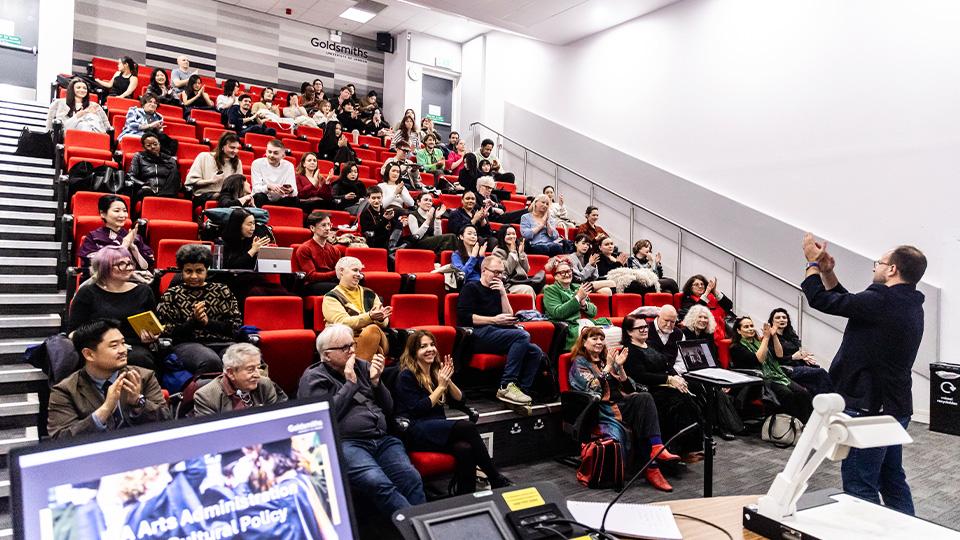
Dr Brkić leads a round of applause at the event
The future vision for the programme was outlined by the programme directors. While Dr Brkić presented new activities planned for next year around discussing difficult questions while embracing the sector’s ‘creative chaos’, Dr Dinardi valued the continuation of industry partnerships via Tricia Jenkins’ industry liaison and the development of more policy partnerships in line with the new Creative Industries sector plan, and highlighted the need to forge further collaborative opportunities with alumni networks abroad, funding bodies, and colleagues in Latin America and Africa, currently underrepresented in the MA student body.
The event closed with a party at the PSH Atrium, where students, alumni and staff chatted and danced to the tunes of DJ Inyongo, our BA Arts Management alumnus.