Design students' creative ideas for Taskmaster, Heatherwick Studio and Serpentine Arts Technologies
Primary page content
Every year, second year BA Design students undertake a major project, working on a live brief set by an external business or organisation. Having been a core part of the course at Goldsmiths for over 20 years, the Live Brief project gives students the opportunity to develop a proposal in response to a real-world challenge, defined by the partner organisation.
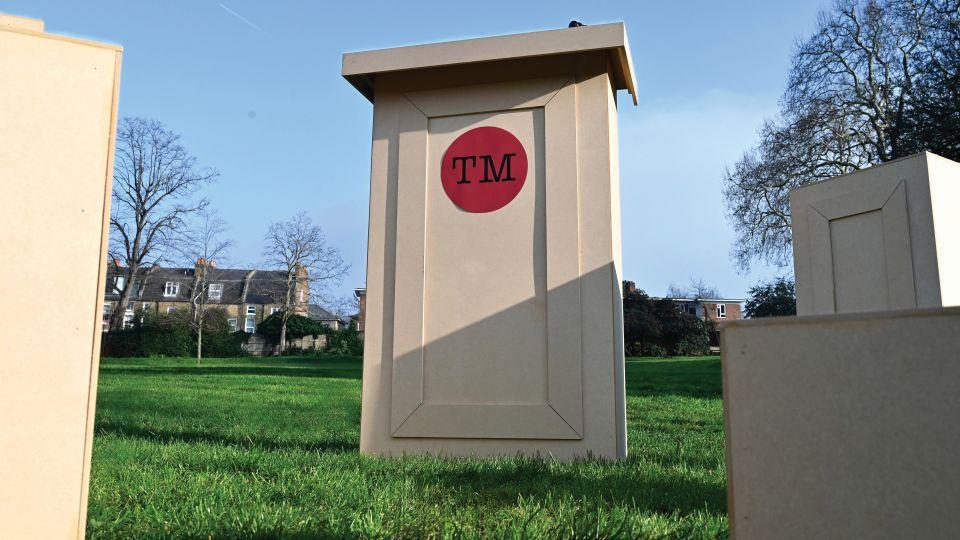
The Judge's Podium by Rachel (Hwaim) Hyun, Ranya Bouchtat, Ayana Ideue, Jung Hyun Kim and Smyra Arora
Creative formulation in a professional environment helps the students to prepare for their careers after Goldsmiths and apply their design skills to the world beyond campus. In 2026, students worked in eighteen small groups to address briefs set by Heatherwick Studio, Serpentine Arts Technologies and Taskmaster.
Heatherwick Studio
The award-winning London-based design and architecture studio, with a team of over 260 architects, designers, makers, engineers and landscape architects working on large-scale projects in cities all around the world, was founded in 1994 by Thomas Heatherwick (who has received an honorary fellowship from Goldsmiths). Neil Hubbard, a Partner at the Studio who was involved with the Live Brief, is also a Goldsmiths graduate. The studio’s ethos is to lead from human experience, with a mission to create buildings and places around us that are radically more joyful, engaging and human.
The brief
The UK’s high streets – once bustling retail hubs and centres of community – are now in decline due to collapse in retail demand, leading to empty shopfronts and a lack of street-level activity. Acknowledging that attempts at regeneration can produce ‘sterilised’ environments, devoid of local character, and impacts of gentrification which privilege high-end consumption, the result is increasingly characterless and bland spaces that become detached from local communities and public life.
Students were asked to propose ways to revitalise the high street, so it might once again become a hub for human connection.
Ricardo Sosa Mejia, Senior Associate at Heatherwick Studio, explained, "High streets have historically been spaces of civic exchange, yet they are undergoing profound transformation and facing significant challenges. We wanted to bring these real-world issues into the studio and tap into the unfiltered creative energy that students bring when tackling complex, open-ended problems."
How the students responded
Different groups came up with a whole range of proposals for revitalising the high street. These ranged from reimagining an under-flyover walkway as a green space harnessing rainwater as a source of atmosphere and play by powering fountains and sustaining plants, creating a 'civic living room' - a communal, outdoor living room – with spaces for play and dining, and even the hypothetical application of elements of a theme park to a Croydon street to engage local children and foreground them in city planning.
For Ricardo Sosa Mejia, three things stood out about the students' responses: "The combination of rigorous thinking and creative freedom in their approach, their fearless willingness to test and prototype ideas physically and their ability to uncover opportunities that may not be immediately visible to architects and urban practitioners."
What stood out was how clearly the work reflected their values, as well as their ability to collaborate and embrace a hands-on approach.
Ricardo Sosa Mejia, Senior Associate at Heatherwick Studio
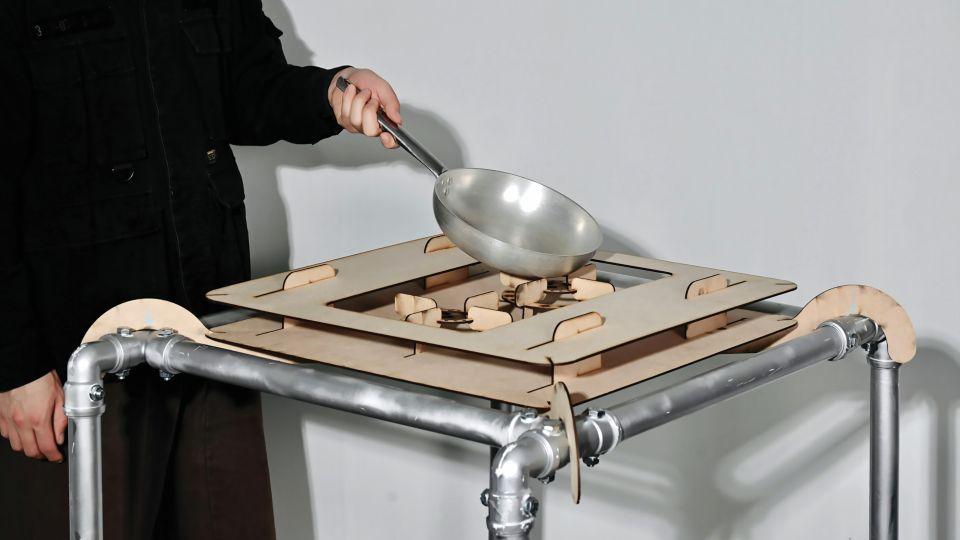
A prototype of how food could be prepared in the pop-up market
-resized.jpg)
Diagrams showing two possible uses of the scaffolding pop-up either as a bike shop or for a barber's
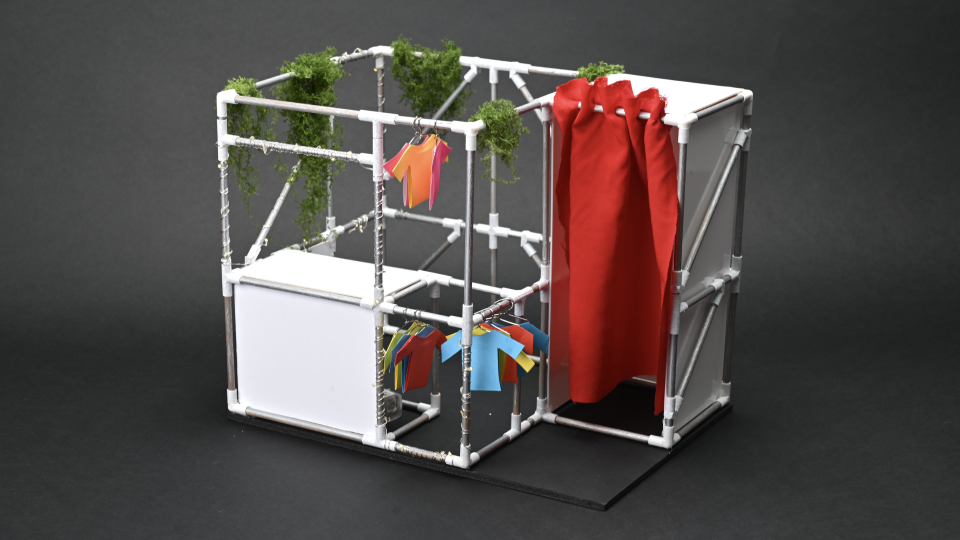
A model of a pop-up clothes shop
Taskmaster
Created by Alex Horne (who studied broadcast journalism at Goldsmiths), the BAFTA-winning comedy game show – soon to air its 22nd series - sees comedians and famous figures compete to find the most imaginative solutions to hilarious and maddening challenges set by the Taskmaster himself, comedian Greg Davies.
The brief
Fans of the show will be familiar with the Taskmaster house, located in a former groundskeeper’s cottage in Chiswick, where the tasks on the show take place. New seasons of the show have seen additions to the garden, like a caravan, a geodesic dome and a stage, to disorientate the new batch of contestants. Students were asked to design a new structure or area for the garden, with the stipulation that the “most useful, exciting, multifaceted, achievable and unexpected structure” would win the admiration of the Taskmaster team. Students also got a chance to visit the house for themselves, to scope out the garden and inspire their designs, taking in the aesthetic of the Taskmaster world – which is full of hidden clues and joke references.
Andy Cartwright, Series Producer at Taskmaster, said: "When the idea of creating a new space in the Taskmaster garden was suggested, the eyes of the lecturers lit up with a startling brightness. We agreed it was a brief that would engage the students, being both challenging and fun in almost perfectly equal measure."
"There are limits to what we can do in the Taskmaster house’s small grounds – and limitations are great to work with. They force creativity in more ways than one with the students having to think about space, budget, safety and filming restrictions – whilst also maximising potential for repeated use and, of course, comedy,” he explained.
We were beyond impressed by the students’ responses to the brief. The variety in their ideas and presentations was a complete delight to witness.
Andy Cartwright, Series Producer, Taskmaster
How the students responded
The responses were as varied as they were imaginative. Some of the ideas presented included a Taskonbury Festival campsite, a wobbling platform dressed as an enclosure for Linda (a statue of a cow that is already a feature of the set), and a pub called 'The Teaspoon'.
Andy Cartwright added, "Each one was unique and presented in a clear, well researched and visually impressive way that always entertained. Thank you to the students for their hard work. It was inspiring, engaging and we wish them all the very best for their futures."

The gavel on the judge's podium
Serpentine Arts Technologies
The brief was developed in collaboration with Victoria Ivanova, Head of Innovation at Serpentine Arts Technologies. Established in 2014, Serpentine Arts Technologies explores the impact of technology through art, research and experimental projects.
The brief
Design as a profession has been hugely impacted by technological changes throughout the past four decades, with the digital revolution fundamentally changing designers’ daily realities. Design as a discipline has also expanded, with design-thinking now applied as a methodology across a wide range of fields, including business. But now we face the AI revolution, and this brief asks – in a world where AI has become the new normal - what tools and infrastructures would a new generation of design professionals need?
Students were asked to explore one of the following challenges: what new tools might help designers keep their work visible while protecting it from AI which scrapes the internet for information without consent or attribution; how design professionals might collectivise to be able to negotiate around AI concerns like training on data, compensation and attribution; what new infrastructures might allow for meaningful consent and transparency in the use of design work for AI training; how designers might engage with AI systems that can produce outputs and what the future generation of designers’ mindset might look like.
How the students responded
Engaging with the very current theme of how AI is impacting people's professional lives, students offered a wide variety of responses to this brief. One group created a typeface for AI resistance that machines would find hard to read (even making the letterpress printing blocks for this), while another group created a ‘perfect’ AI collaborator to explore the complex future of creative partnerships, and another group developed a slow AI to maintain human agency and the place of iteration in the creative process.
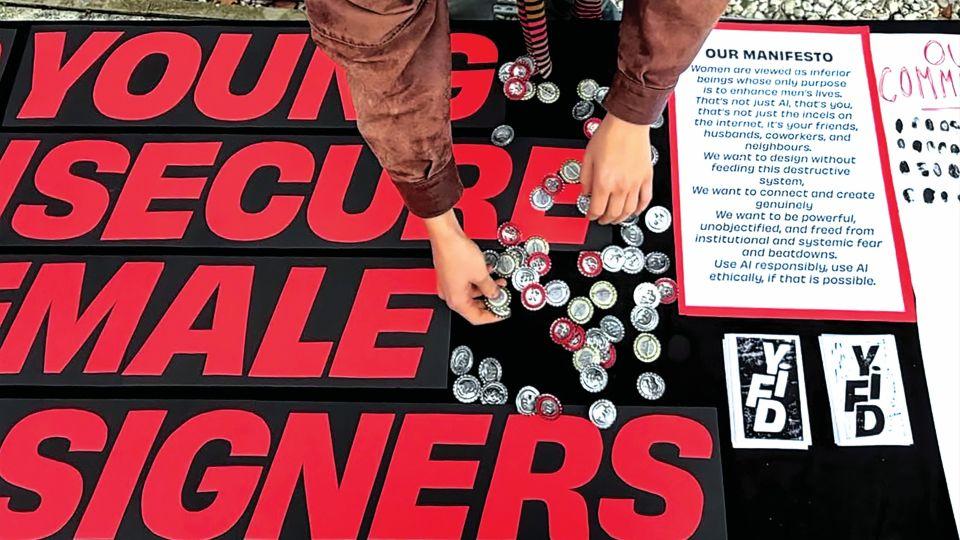
Young insecure Female Designers
We were impressed by the richness and diversity of the responses across all projects. It's only a four-week project, but the students produced really conceptually strong responses to the briefs.
Arjun Harrison-Mann, Lecturer in Design and Co-Lead of Year 2
Two decades of Live Briefs – what our students gain
Having been a cornerstone of BA Design at Goldsmiths for some two decades, the Live Briefs has built up a culture and community, helping students to tap into a network of industry professionals and gain genuine real-world insights that equip them for the next steps in their careers in design.
Carolyn Kirschner, Lecturer in Design and Co-Lead of Year 2, explains: "The second year helps students shift closer and closer to what the world of design looks like outside of the university, and where they might see themselves fitting in. The Live Briefs are a step along the way which gives them a taste of the design world out there and real experience in industry."
"BA Design at Goldsmiths is not split into different disciplines, which gives students space to work out that their practice is going to be. Part of the idea of this project is to show the variety of forms of practice that exist out there."
Arjun Harrison-Mann, Lecturer in Design and Co-Lead of Year 2, added, "It also demonstrates the value of interdisciplinary practice. Working in their small groups, the students can act like a micro-studio, each bringing different skills and combining different ways of thinking. The Live Brief project shows them that their way of looking at the world matters - designers are brought in to provoke, and question and reshape briefs."
Stuart Bannocks, Senior Lecturer and Programme Lead for BA Design, reflected on the Live Brief as a long-standing part of the course at Goldsmiths: "The live briefs are invaluable opportunities not only for our students, but also for us as a subject, a discipline, and a team to reflect on and inform how we shape and develop education across our curriculum."
For Stuart, the connections and dialogues with industry professionals also help shape teaching so that students are best equipped for life after graduation: "The Live Briefs help us frame not only what we teach, but also how we work, year on year, to discover and rediscover the role that design, and designers themselves play in our societies. They challenge established ways of thinking about how we equip our students and graduates to flourish in the world as it is, while also pointing towards new horizons, new expectations, and new lines of enquiry."
It's such a privilege to work alongside so many incredible partners and to reflect together on how creative education continues to produce such a wealth of possibility, positivity, and lasting value.
Stuart Bannocks, Senior Lecturer and Programme Lead for BA Design