Professor wins award for contribution to media and democracy studies
Primary page content
Natalie Fenton, Professor of Media and Communications, has been awarded the Media and Democracy Karol Jakubowicz Award for her book Democratic Delusions: How the Media Hollows Out Democracy and What We Can Do About It (Polity, 2025).
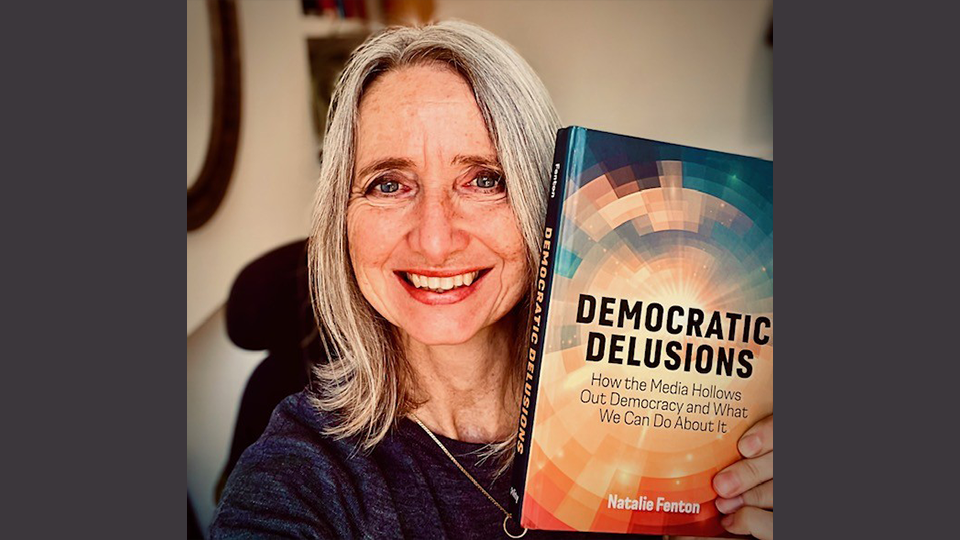
Professor Natalie Fenton with a copy of her award-winning book, Democratic Delusions
Professor Fenton’s work was chosen from five nominees, all works addressing the relationship between media and democracy.
The Media and Democracy Karol Jakubowicz Award was established in 2018 with the goal of supporting scholars who contribute to studies on democracy, human rights, media ethics, media policy and public service media.
Announcing the 2026 winner, the Polish Communication Association said of Democratic Delusions, “The publication challenges dominant assumptions about the role of media in democratic societies and proposes alternative models of media organization and ownership, including the concept of Media Commons, pointing to directions for institutional reform and media policy.”
Professor Natalie Fenton said, "I’m delighted to have this international acknowledgement. The book is a big picture analysis, taking into account power and powerlessness, political participation and exclusion, trust and distrust, equality and injustice, the public good and private interest, freedom and repression, hope and hopeless – it brings in literatures and research across a lot of disciplines to try and both understand and then to reimagine the relationship between media and democracy."
Democratic Delusions
There are two delusions that are central to Professor Fenton’s argument. Firstly, she argues that it is a delusion, oft-repeated by media corporations and tech companies, that the mainstream media (in its current form) supports, a thriving democracy (in its current form). Rather, she argues that despite frequent assertions of a vital link between a free, independent media and a healthy democracy, the state of both and nature of the relationship is rarely interrogated. For Professor Fenton, the media is neither free or independent when it is subsumed by commercialism and entrenched in digital capitalism such that it mostly serves institutions and elites.
Secondly, the book argues that the current neo-liberal version of democracy is also a delusion – that it has become disconnected from the central essence of democracy, whereby every person can participate in society and forms of governance equally and for the common good. She points to the fact that many people feel let down by politics (and democracy in its current form), and that it is not delivering for them, while a small minority of society is profiting.
A free media is supposed to lead to a healthy democracy, but in many parts of the world democracies are dying or on the demise and many forms of media as we know them have contributed to this decay.
Professor Natalie Fenton
The book is an unapologetically big picture analysis – with Professor Fenton arguing that it is vital to critically deconstruct democracy as we know it and re-imagine what democracy could become and what a democratic media might be.
"I hope the book adds to a critical theory of democracy as the deepening and extension of the egalitarian imagination in the fields of media and communications. It is not only an attempt to rethink how we conceive of media and communications in relation to this thing called democracy and some of its defining characteristics, but it is also an attempt to future think what democracy might or could be in a mediated world to come," Professor Fenton said.
What might a different media look like?
The books puts forward the idea of the media commons – an array of alternative models for media and tech, ranging from hyper-local to international, all with the focus on the common good over private gain. She argues that this would need more citizen control (including when it comes to editorial decision-making) and to be separated from the for-private profit model.
She argues that one reason for a loss of trust in the media is that systemically disadvantaged and minoritised groups see themselves as under or mis-represented. One way to enhance trust would to be to improve accountability measures and even introduce a citizen-led regulator.
Despite the current information overload online – where misinformation is rife – and the digital revolution wreaking havoc on the traditional newspaper business model, Fenton asserts that people still do want news: "People still want and will read news if they understand where it comes from, see themselves fairly reflected in the stories that are told and are able to contribute to them in a meaningful way. This will need democratic governance and control by workers, users and communities and real accountability to the people that media and digital platforms serve." She adds, "It’s not just about news media holding power to account, news media also need to address powerlessness too."