Exploring the future of the creative economy at the ASEAN-UK symposium
Primary page content
A team from Goldsmiths, led by Professor Jonathan Freeman, flew out to Manila to participate in a symposium hosted by the Association of South-East Asian Nations (ASEAN). The team ran a consultation workshop to define a new ASEAN Centre of Excellence for the Creative Industries, shared their insights and experience, and planned future collaborations to advance the creative economy across ASEAN.
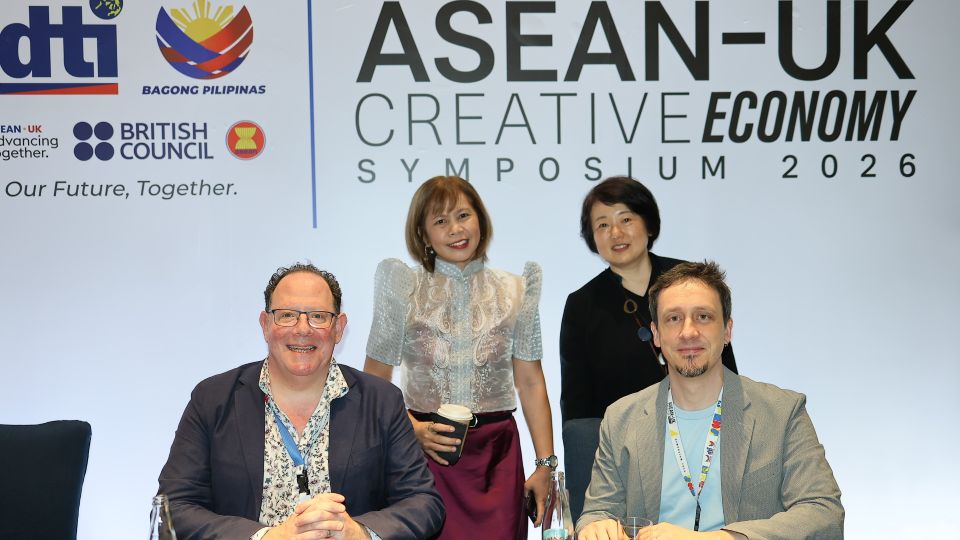
Professor Jonathan Freeman and André Piza at the official Memorandum of Understanding signing
The ASEAN-UK Creative Economy Symposium 2026 took place over two days in Manila, Philippines, in partnership with the British Council – a non-departmental public body funded by the UK Foreign, Commonwealth and Development Office (FCDO). It brought together policymakers, industry leaders, development partners, academics, and creative practitioners from the ASEAN member states and the UK to share insights and best practices, as well as discuss strategic areas for collaboration. The symposium involved thematic dialogues, workshops and networking events as well as a showcase of the region’s creative industries spanning sectors like fashion, music, craft, performance, dance, games and film.
The team of Goldsmiths researchers engaged over 120 attendees in a 3-hour consultation workshop led by Professor Freeman to inform the direction of travel for the new ASEAN Centre of Excellence in Creative Industries. The workshop included a private screening of the CoSTAR Foresight Lab film ‘Moments, Praxis, Paths: Scenarios for the Creative Industries in 2040’ - a video essay exploring four possible futures for the creative industries by 2040 – to provoke thinking about the possible futures of the creative industries in the region.
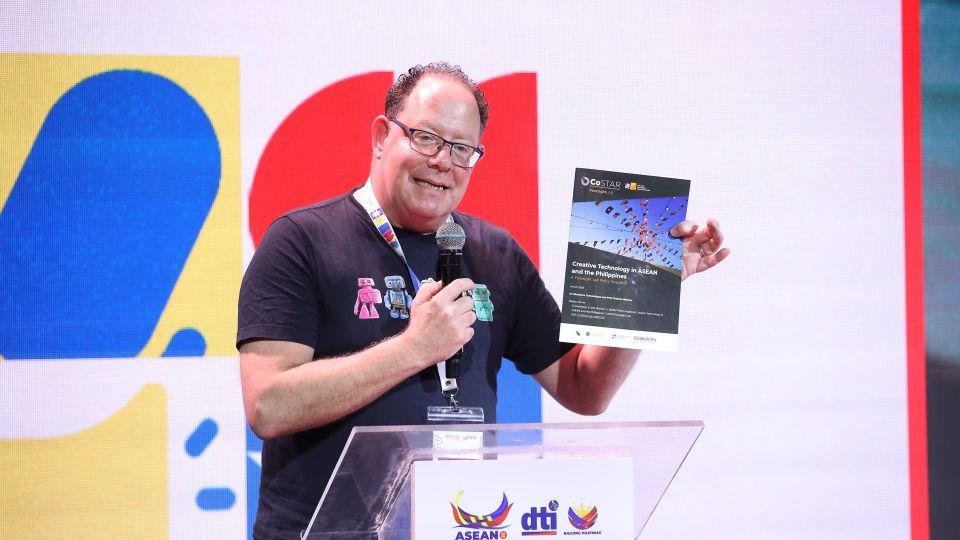
Professor Jonathan Freeman speaking at the symposium
Professor Freeman (School of Mind, Body and Society) was accompanied by team members from Goldsmiths-based i2 media research, a research consultancy spin-out which interrogates how humans and technology interact and CoSTAR Foresight Lab, which is based at Goldsmiths and researches the adoption, use and impact of new technologies in games, film, TV, performance and digital entertainment. Those joining Professor Freeman included Noemi Ponzoni (Research Lead) and Anna Stewart (Research Psychologist) from i2 media research, André Piza, Programme Manager at CoSTAR Foresight Lab and Joshua Dedman (Consultant, Olsberg SPI – a delivery partner of CoSTAR Foresight Lab).
What was particularly striking at the ASEAN–UK Symposium was the openness and confidence of the dialogue across the region. There was a strong commitment to cross‑border learning, a willingness to challenge established models, and a clear focus on how creative industries infrastructure can be strategically reshaped in response to rapid economic, technological, and cultural change.
Professor Jonathan Freeman, School of Mind, Body and Society, Director of CoSTAR Foresight Lab and Managing Director, i2 media research
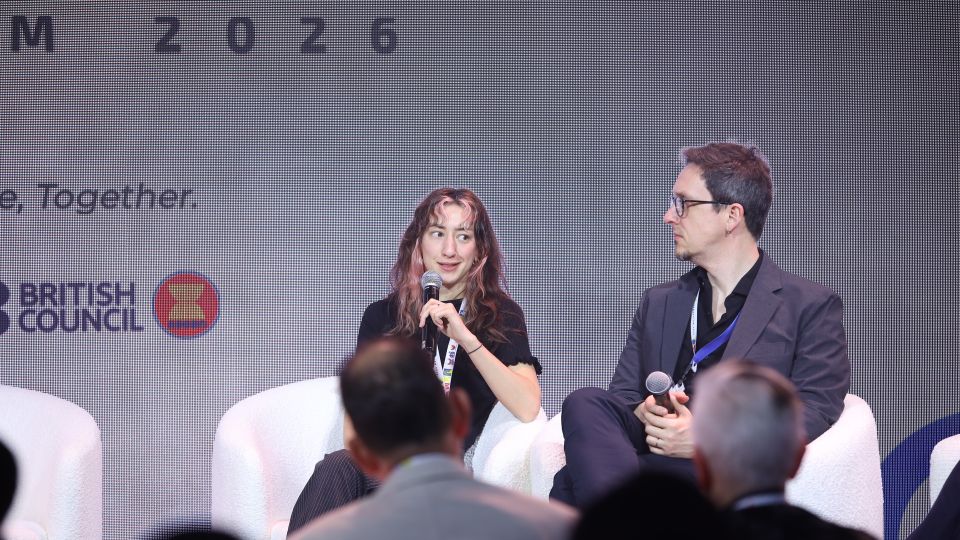
Noemi Ponzoni, Research Lead, i2 media research and André Piza, Programme Manager at CoSTAR Foresight Lab
Memorandum of Understanding
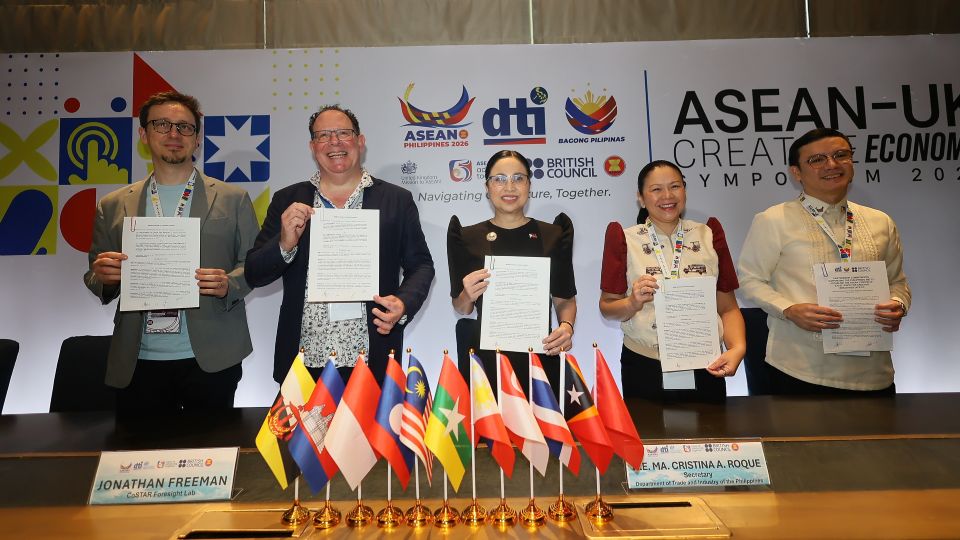
The official signing of the Memorandum of Understanding
As part of the symposium, there was a signing ceremony for a Memorandum of Understanding (MOU) partnership between the Department of Trade and Industry, Philippines and CoSTAR Foresight Lab. The MOU was formalised by Sec. Cris A. Roque and Professor Jonathan Freeman.
This MOU is a step towards integrating data, insights and future-thinking approaches into the creative economy of the Philippines.
André Piza said, “The signing of the MoU and the workshop with ASEAN delegates turned the Symposium into a platform for action, allowing us to work directly with regional partners on shaping the future of their Creative Industries Centres of Excellence, and it was particularly encouraging to see such a strong appetite for further research and data to support long‑term development across the region.”
Professor Jonathan Freeman said of the Symposium, “For us at the Foresight Lab, it underlined the importance of long‑term, research‑led partnerships between governments, institutions, and industry in supporting sustainable regional development—unlocking commercial opportunity, strengthening private‑sector growth, and ensuring creative economies deliver both public and market value over the long term.”