Success in challenge reimagining beauty industry
Primary page content
MA Luxury Brand Management graduates came together as part of the international IMAGINE Challenge to answer the question “who is luxury really for and who continues to be excluded?” The resulting project was selected as a winner, with the team awarded a trip to New York.
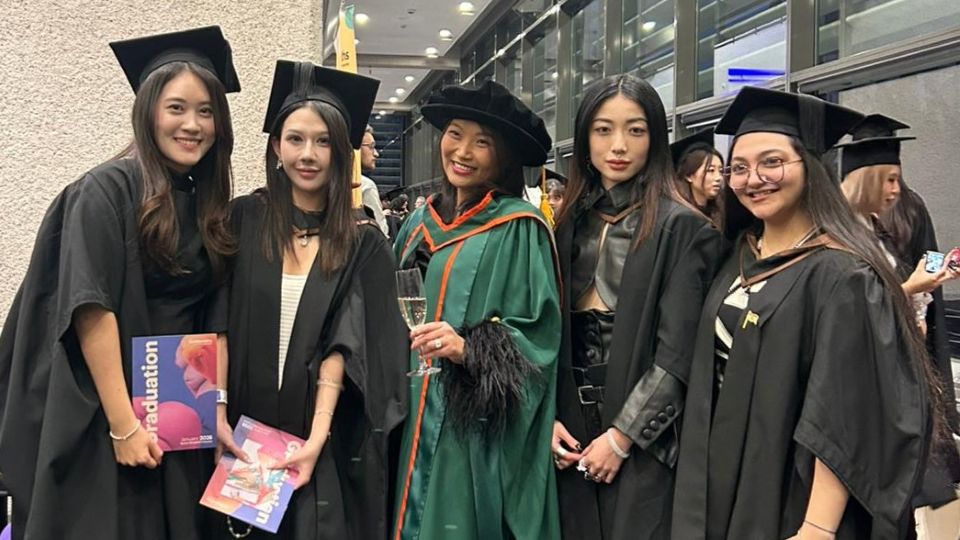
The Goldsmiths team at their graduation for MA Luxury Brand Management with Programme Director Dr Kelly Meng. Left to right: Chae Young Kim, Chenxiao Wu, Dr Kelly Meng, Ling Chieh Meng, Preety Kaur
Ling Chieh Meng (Lin), Chae Young Kim, Chenxiao Wu and Preety Kaur combined their diverse cultural, academic and professional backgrounds to meet the challenge. Approaching the challenge as an opportunity to translate academic research into real industry insight, they focused on representation, inclusion and engagement within the beauty and luxury sectors.
The Imagine Challenge is part of Institut Francais de la Mode’s (IFM) ‘Diversity in Beauty’ collaboration with world-leading fragrance design company MANE. MANE asked participating teams from five institutions in the UK, France, USA, China and Brazil to reimagine beauty and rethink representation in the beauty industry. They were tasked with conducting a research project exploring excluded groups and how to challenge this exclusion in international fashion and beauty brands.
The Goldsmiths team were selected as winners, with the three winning groups awarded a trip to New York and a chance to present their research to MANE representatives at their head office.
I’m proud of the team. Their project is exactly what we champion at Goldsmiths: critical, culturally aware and industry ready. They moved beyond slogans to show, with evidence, how inclusion can be designed into the beauty experience - and luxury brands can act on it now.
Dr Kelly Meng, Head of Subject - Business, Management, Marketing
MANE is an international flavour and fragrance design company, which works with brands like Armani, Diptyque and Jo Malone.
Reimagining the beauty industry
The Goldsmiths team chose to focus their research on consumers with visible skin differences - including acne, scarring, pigmentation, and birthmarks - groups often marginalised through idealised beauty imagery and narrow definitions of luxury.
“Our research focuses on groups that are often overlooked within the beauty and luxury industries,” Chenxiao Wu explains. “The exclusion they experience is rarely overt; instead, it operates through subtle and indirect mechanisms, most notably in brand imagery, product design and advertising representation.”
Chae Young Kim describes this exclusion as emotional as much as visual. “They are emotionally invested in beauty but often feel unseen or distanced by brands,” she says, pointing out how perfection-driven standards subtly signal who does and does not belong.
Ling Chieh Meng traces her initial interest back to influencer Nikki Lilly’s appearance on a Paris runway, questioning whether such moments represent structural change or isolated exceptions. “Our research therefore focuses on exploring how individuals with visible skin differences experience beauty and luxury in everyday life,” she says.
Working collaboratively, the team conducted cross-cultural qualitative research across Asian markets, with each member contributing insights from their own cultural background. “Our team members come from different Asian countries and cultural backgrounds,” Chenxiao notes. “Each of us naturally brought our own social experiences and observational perspectives into the discussion.”
Preety’s research on India highlighted how exclusion is intensified through “social judgement and deeply ingrained beauty norms,” while still revealing strong emotional engagement with beauty and luxury products.
Presenting to industry experts
The team from Goldsmiths along with teams from NYU (USA), IFM (France), Donghua University (China), Fundação Getulio Vargas - FGV (Brazil), with each supervised by an academic at their institution, gave an online presentation and defended their work in front of representatives from MANE, as well as producing a 20-page report presenting their research and evidence-based recommendations.
Defending their research in front of industry representatives from MANE was both challenging and affirming. “It was extremely nerve-racking,” Chenxiao admits, “but it made me realise how much I have grown in both my research skills and my ability to articulate ideas.” Chae emphasises the importance of translating theory into action: “We worked hard to demonstrate not just why our ideas mattered conceptually, but how they could be useful and valuable for the industry in practice.”
Lin added, “It was a very valuable learning experience. The panel was supportive and offered practical, constructive feedback, which made the process encouraging rather than intimidating.”
Luxury Brand Management at Goldsmiths
All four cite the MA Luxury Brand Management at Goldsmiths as instrumental in shaping their critical perspective. Instead of simply accepting luxury as something to be admired, the programme encourages close critical analysis of power, representation and cultural influence.
“What attracted me to Goldsmiths is its strong emphasis on critical thinking, rather than encouraging students to simply celebrate brands,” says Chenxiao. Chae adds that the course’s interdisciplinary focus — spanning fashion, art, culture and creative industries — helped her understand luxury “as a cultural system, not just an industry.”
For Chenxiao, the journey into luxury brand management began with design. “I studied Jewellery Design at undergraduate level and have long aspired to create my own brand in the future,” she explains. “During an internship at a jewellery brand, I gradually realised that building a successful brand depends on far more than design alone. It also requires commercial thinking, strategic brand management, and a sensitive understanding of markets and consumers.” Studying luxury brand management, she says, offered a way to understand “how different luxury brands operate, laying a more comprehensive foundation for my future career.”
Chae came to the discipline from fashion and fine arts, drawn to luxury as a cultural system rather than a product category. “I’ve always been interested in how luxury goes beyond products and becomes a cultural language — something that shapes taste, identity, and aspiration,” she says. “Over time, I became more curious about the strategic side of that process: how brands manage meaning, emotion, and long-term value, not just aesthetics.”
Lin’s route into the industry was more accidental. “Luxury PR was my first job after graduation, so entering the luxury industry wasn’t a grand plan but just happened,” she reflects. But exposure quickly led to deeper questioning. “You begin by executing ideas, and then you start asking better questions: why does this brand work, and why does another one feel empty? This shift from doing campaigns to questioning brand systems is what led me to luxury brand management.”
For Preety, cultural context was central. “Coming from India, I have always been exposed to strong ideas of heritage, craftsmanship, and status,” she says. “Over time, I realised that what makes luxury powerful is not only design or quality, but the way brands manage aspiration, storytelling, and cultural meaning across different markets.”
Ultimately, the challenge reshaped how the students think about luxury brand management itself. “Brand management is not only about markets and profitability, but also about social responsibility, inclusion, and respect for diverse identities,” says Chenxaio. Lin goes further: “Representation is often discussed as a moral issue, but it’s also a strategic blind spot.” Repeating narrow ideals, she argues, forces brands into competition for the same consumers, while ignoring “emotionally engaged, high-potential consumers who are consistently overlooked.”
Read more about the Memorandum of Understanding between Goldsmiths and the Institut Francais de la Mode