New project aims to improve children’s experiences of medical procedures
Primary page content
New project from King’s College London and Goldsmiths University brings engineering and art together to improve how children experience medical procedures.
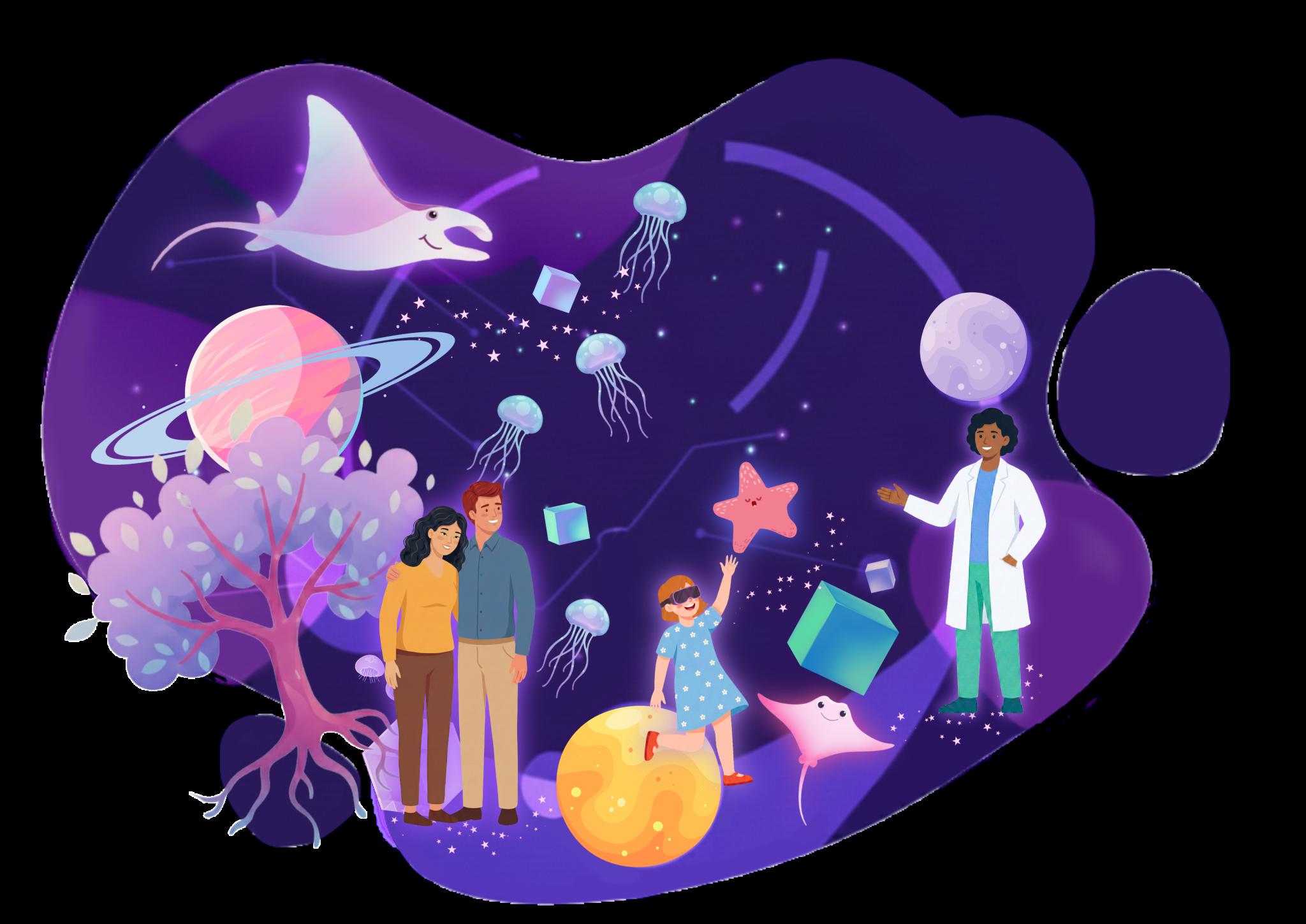
A magical world VR environment designed by Chaoling Li
Although clinical care aims to treat illness and improve quality of life, the care journey itself can be traumatic, particularly for children who require repeated examinations and interventions. In this situation, carers and parents are caught in an impossible position, wanting clinicians to achieve the best possible procedure outcome, while wishing to comfort and protect their child. This situation is compounded for the children over time, as the resulting cycle of stress and fearful anticipation can amplify the trauma associated with unpleasant medical procedures.
To address this, UKRI have awarded King’s College London and Goldsmiths University £958,729 for a joint project to develop a new medium, known as Asymmetric Reframed Reality (ARR), designed to transform how children experience medical procedures.
ARR will harness the powerful effect of reframing, a psychological approach that changes how a person views a situation, leading to different emotional responses even when experiencing the same external stimuli.
Unlike traditional virtual reality approaches that focus on distraction, ARR will aim to engage children in procedures, offering a different narrative to explain the same physical reality. For example, while having an injection in a hospital room, the child will see a magical world surrounded by mermaids (clinician and carer) with a naughty fairy dancing on their arm.
By reframing the narrative surrounding a procedure, ARR will aim to reduce distress and anxiety, helping children experience clinical interventions in a more positive way.
The team will create prototypes for a variety of age-appropriate multisensory experiences. They will bring children’s active voices into the project at all stages, with artists working closely with children to create innovative and engaging virtual worlds that can be used both in the clinical setting and as modes of artistic experience.
Bringing together King’s expertise in novel engineering, developmental psychology and paediatric medicine with Goldsmiths’ expertise in computer arts, game design and immersive healthcare technologies, the project represents a highly interdisciplinary approach to improving paediatric care.
Jo Hajnal, Professor of Imaging Science at King’s and project lead, commented: “For this project we assembled a new collaboration spanning experts from medicine, engineering, psychology, immersive technology, the arts working together with children and their families. We will take a fresh look at a real-world problem that faces children who struggle to cope with the medical procedures they need. We aim to create a novel technology that makes a pivotal difference – not only enabling the child patient to have a more positive experience with much less stress, but also allowing them to cooperate much more effectively during treatment, hopefully improving outcomes.”
Sylvia Pan, Professor of Virtual Reality at Goldsmiths and co-lead on the project commented:
I feel really privileged to have the opportunity to work with medical doctors and apply our years of research in immersive technology to make a real impact on children’s lives; and I look forward to working with artists to achieve this goal together.
Sylvia Pan, Professor of Virtual Reality
Marco Gillies, Professor of Computing at Goldsmiths and co-lead on the project commented: “We are excited to start this new project that will push forward immersive technology as a creative medium and make life better for young patients.”