Hackathon explores how VR can reframe negative experiences
Primary page content
Goldsmiths' Social, Empathetic and Embodied VR Lab (SEE VR Lab), with colleagues from King's College London, hosted a hackathon on campus where students and alumni competed to design the best immersive experience using virtual reality (VR) to reframe an experience and alter participants' perception of it.
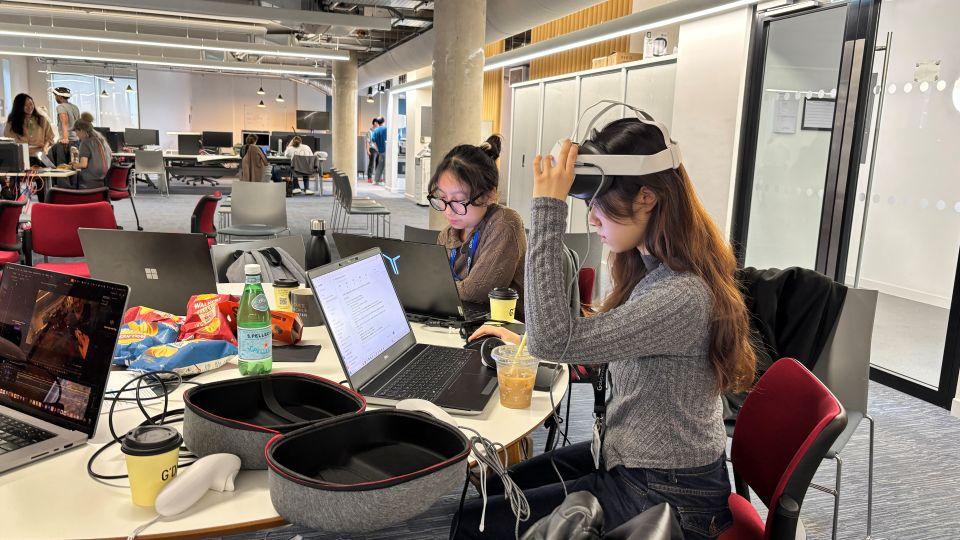
Participants in the ARR hackathon working with a VR headset
Almost 50 participants in 17 teams participated in the hackathon, which lasted three days, coming up with different ideas for how VR could be used to help children in hospital. As well as Goldsmiths students and alumni, participants included students from King's College London, Swansea University and University College London.
Can VR make you perceive an experience differently?
The hackathon was centred around the concept of Asymmetric Reframed Reality (ARR), which draws on the concept of Reframing from Cognitive Behavioural Therapy (CBT). It changes how an experience is interpreted, so a different emotional response can result from the same physical event. It is not just distraction – as the person remains present but perceives the event differently.
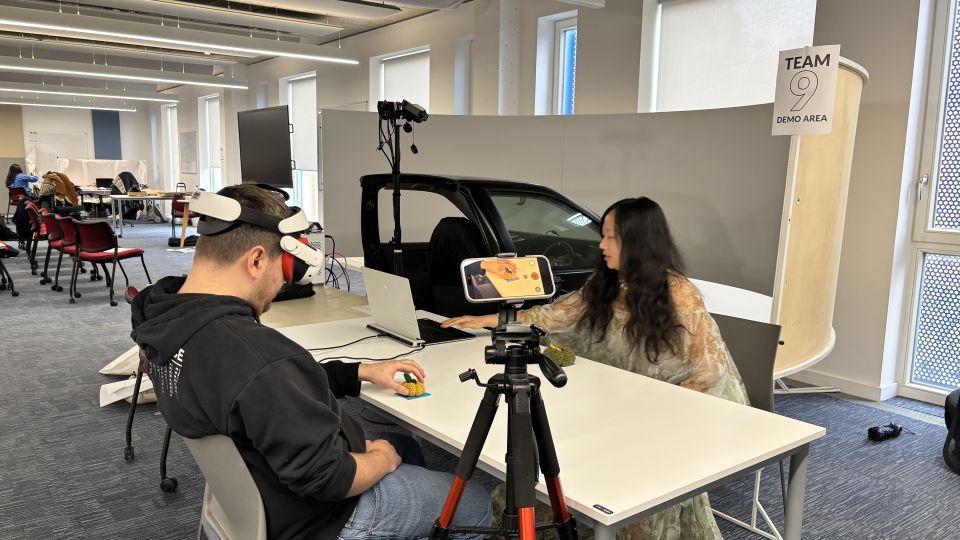
Using VR technology to develop ideas
The challenge
Participants were tasked with designing a prototype of an immersive or spatial experience that gives a new meaning to a real physical interaction. The reframing could be from negative to positive perception for one person involved, or a contrast in perceptions of the same interaction for two or more people.
VR headsets and a range of haptic devices were available for the teams to use. The teams were competing for a first prize of a £400 voucher, with a £150 voucher for second place and a £50 voucher for coming third.
The hackathon opened with introductory talks to explain the key concepts of reframing and immersive technology, followed by initial brainstorming. Teams then had time to develop their ideas, with support for their work-in-progress prototypes, and on the final day groups gave presentations to showcase what they had come up with.
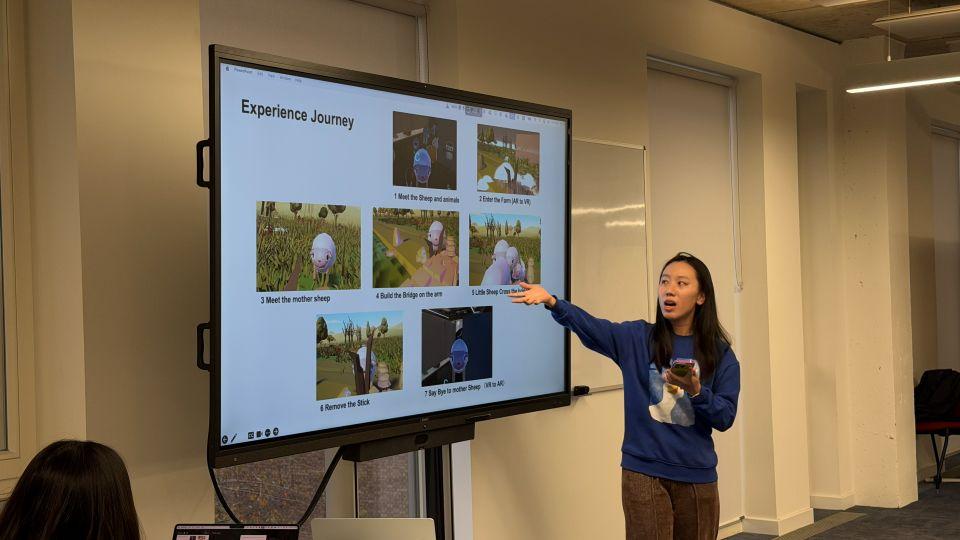
Yiqing (Ivy) Tian presents to the group
How can perceptions be transformed using VR?
The team who placed second, including UCL PhD students Jingyi Zhang and Junyi Zou (who completed her MA at Goldsmiths), and Goldsmiths second-year PhD student and member of the SEE VR Lab team Yiqing (Ivy) Tian, developed a prototype to help turn a medical procedure into a more empowering experience from a child’s perspective. Called "Sheep in the Wonderland", their prototype involved using VR to reframe the experience of cast or K-wire removal following a broken bone.
The patient would need to keep their arm still, which is reframed by using VR to visualise their arm as a bridge, with little sheep using it to cross a dangerous river. Using VR, the sheep would appear to be there in the consultation room, and the child's arm would gradually transform into a bridge within a virtual farm. Sensations from the procedure were reframed as part of the story, aligning with sounds and sensations in the narrative of the experience. Ivy Tian explained, "Through this approach, we explored how Asymmetric Reframed Reality could help children shift from feeling like passive patients to active participants with a sense of purpose and accomplishment."
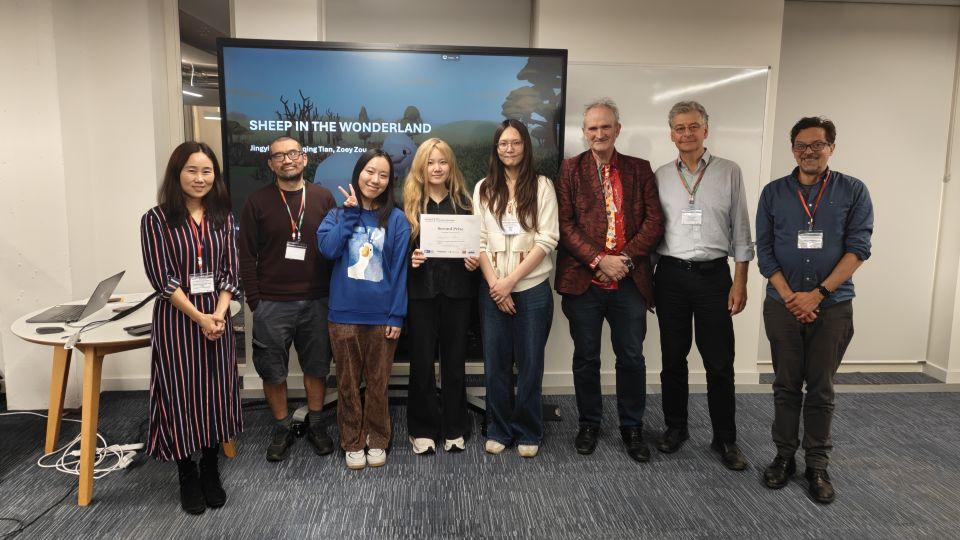
The team behind "Sheep in the Wonderland", who came second place, with Professor Xueni (Sylvia) Pan (left), Professor Tomoki Arichi from KCL (second from left), Professor William Latham (third from right), Professor Jo V Hajnal from KCL (second from right) and Professor Marco Gilles
She added, "I also really liked that we were working on a real healthcare challenge. Of course, nobody expected us to create something that could actually be used in a hospital after 48 hours, but we still had to think carefully about what children might be feeling during these procedures, how doctors and nurses would be involved, and what parents might need or worry about. It made me think much more about how a design would work in a real-world setting."
The idea that XR could help people experience something differently or even change how they react to a difficult situation, is really exciting to me. Being able to use technology to address a real problem, even in a small way, is something I'd love to keep exploring.
PhD student Ivy Tian
The team placing third produced a project called Step by Stem. This team included Goldsmiths alumni Kira Guo (MA Games and Playful Design graduate) and Quince Gore-Rodney (MA Virtual and Augmented Reality graduate), and current postgraduate students Nova Oughton, who is studying Virtual and Augmented Reality and Hakan İyimaya, who is studying Clinical Psychology.
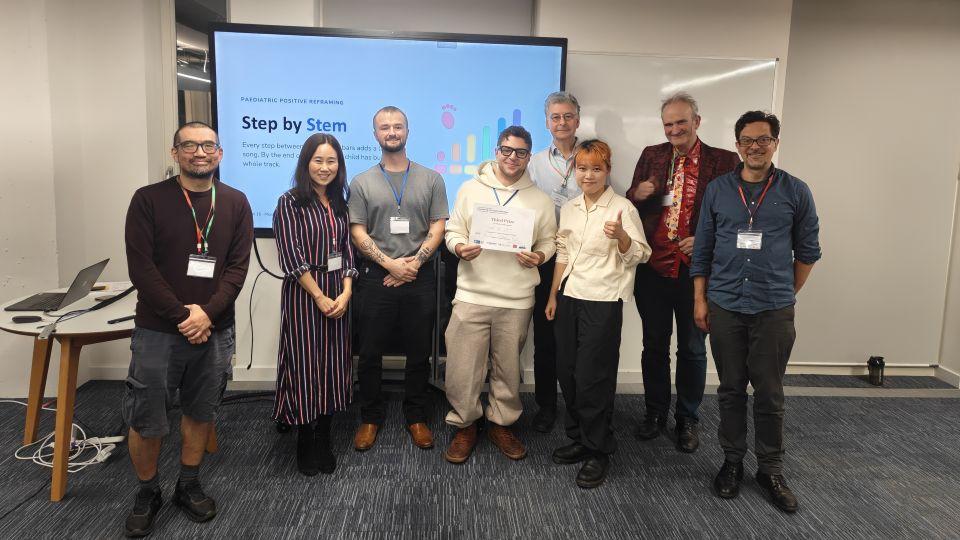
The Step by Stem team, who placed third, with staff from Goldsmiths and King's College
Their idea sought to help children with cerebral palsy while practising walking in physiotherapy. With the child using a VR headset, coloured stepping stones would appear and reaching each stone would reveal another layer of a song. An augmented-reality app would be available to parents that would show past performance, so that progress could be measured.
First place went to a team from King’s College who developed Terra. The concept of Terra is that a child could build a virtual world in VR, nurturing virtual plants with the help of a parent or guardian who is with them, while undergoing medical care for a wound requiring stitches. As well as first, second and third place, four teams got special mentions for their innovative ideas.
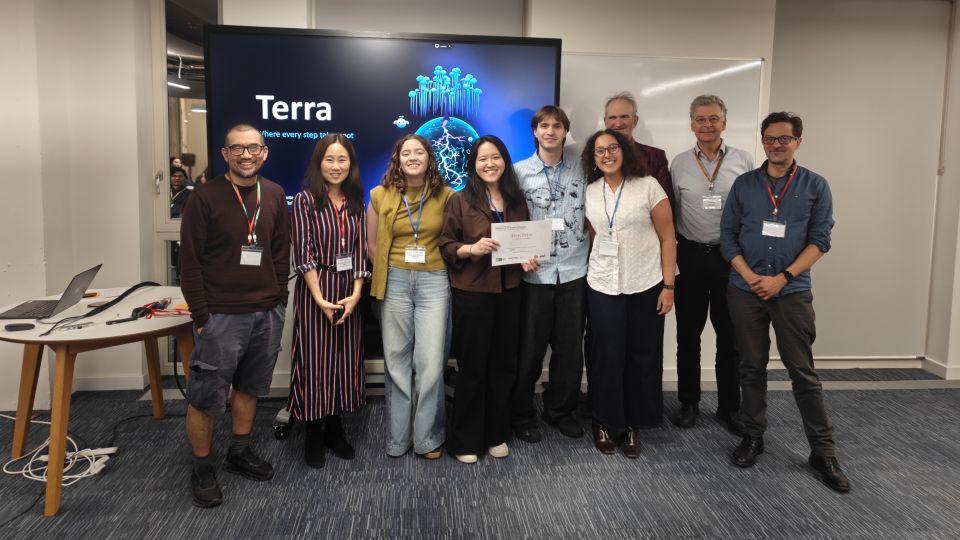
The Terra team, who came first in the hackathon, with staff from Goldsmiths and King's College
The organisers included Goldsmiths School of Computing's Professor Xueni (Sylvia) Pan, Professor Marco Gillies, Professor William Latham, Research and Innovation Associates, Fang Ma and Yuke (Claire) Pi. They were joined by colleagues from King’s College London including Professor Jo V Hajnal, Professor Tomoki Arichi, Dr Ildar Farkhatdinov, Professor Emily Jones, Dr Kun Qian and ChunJou (Celine) Yu.
The hackathon was part of the UKRI-funded research project between Goldsmiths and King's College London which is exploring how ARR might transform how children experience medical procedures.